Complete Guide: Retirement Planning in 2025
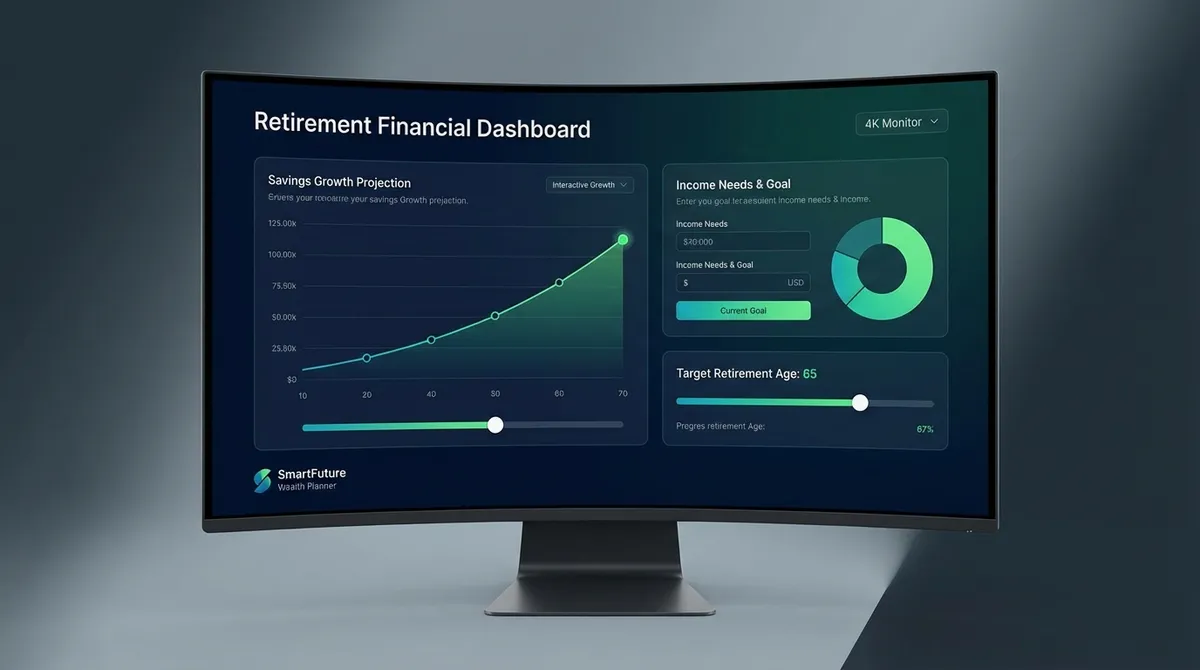
Planning for retirement in 2025 requires a clear understanding of your financial goals, realistic savings benchmarks, and the right tools to project your future. With Social Security facing potential shortfalls and healthcare costs continuing to rise, taking control of your retirement income planning has never been more critical. Our retirement calculator helps you cut through the complexity and get actionable insights tailored to your specific situation.
Why Retirement Planning Matters More Than Ever in 2025
The retirement landscape has shifted dramatically. According to recent Federal Reserve data, the average American in their 60s has just $182,100 saved for retirement—far below the recommended $1 million+ needed for a comfortable retirement. With life expectancy reaching 90 years for many Americans, your retirement age and savings may need to last 25-30 years or more.
The good news? Starting early and contributing consistently can make an enormous difference. Thanks to compound interest, a 25-year-old saving $500 monthly could accumulate over $1.3 million by age 67 (assuming 7% annual returns), while someone starting at 45 would need to save $2,200 monthly to reach the same goal.
Retirement Savings Benchmarks by Age: Where Do You Stand?
Financial experts recommend having specific multiples of your annual salary saved at different ages. These benchmarks help you gauge whether you're on track:
2025 Retirement Savings Targets:
- Age 30: 1x your annual salary (median: $50,000)
- Age 35: 2x your annual salary (median: $120,000)
- Age 40: 3x your annual salary (median: $225,000)
- Age 45: 4x your annual salary (median: $340,000)
- Age 50: 6x your annual salary (median: $510,000)
- Age 55: 8x your annual salary (median: $720,000)
- Age 60: 10x your annual salary (median: $950,000)
- Age 67: 12x your annual salary (target: $1.2+ million)
If you're behind these benchmarks, don't panic. The key is to start where you are and increase contributions systematically. Even small increases make a significant difference over time.
2025 Contribution Limits: Maximize Your Tax-Advantaged Savings
Understanding current contribution limits helps you optimize your retirement strategy. For 2025, the IRS has set these limits:
401(k) Plans:
- • Standard limit: $23,500
- • Catch-up (50+): +$7,500 = $31,000 total
- • Super catch-up (60-63): +$11,250 = $34,750 total
- • Employer + employee total: $70,000
IRA & Roth IRA:
- • Standard limit: $7,000
- • Catch-up (50+): +$1,000 = $8,000 total
- • Roth IRA income limits: $150K (single), $236K (married)
- • Traditional IRA deduction phases out with workplace plan
Investment Strategies by Age: Tailoring Your Approach
Your investment strategy should evolve as you age, balancing growth potential with risk management:
In Your 20s and 30s: Aggressive Growth
Time is your greatest asset. You can weather market volatility and benefit from decades of compound growth.
- • Stock allocation: 80-90% in diversified index funds
- • Focus: Total stock market and international index funds
- • Strategy: Maximize contributions, automate investing
- • Risk tolerance: High—embrace market fluctuations
In Your 40s: Balanced Growth
Shift slightly more conservative while maintaining growth potential to catch up if needed.
- • Stock allocation: 70-80% with 20-30% bonds
- • Focus: Diversified portfolio with emerging markets
- • Strategy: Increase contributions with raises, consider Roth conversions
- • Risk tolerance: Moderate to high—still 20+ years to retirement
In Your 50s: Moderate with Capital Preservation
Prioritize capital preservation while still achieving growth to combat inflation.
- • Stock allocation: 60-70% with 30-40% bonds
- • Focus: High-quality dividend stocks, municipal bonds
- • Strategy: Maximize catch-up contributions, pay off mortgage
- • Risk tolerance: Moderate—reducing volatility as retirement nears
In Your 60s: Conservative Income-Focused
Preserve capital and generate reliable income streams for retirement.
- • Stock allocation: 40-50% with 50-60% bonds and cash
- • Focus: Dividend aristocrats, Treasury bonds, annuities
- • Strategy: Create withdrawal strategy, optimize Social Security timing
- • Risk tolerance: Low to moderate—capital preservation priority
Social Security Optimization: Maximizing Your Benefits
Social Security provides a foundation for retirement income, but the timing of when you claim benefits significantly impacts your lifetime income:
2025 Social Security Claiming Strategies:
Claim at 62 (Early):
• 75% of full benefit
• Permanent reduction
• Best if: health concerns, need income
Claim at 67 (Full):
• 100% of full benefit
• Standard retirement age
• Best if: average health, still working
Claim at 70 (Delayed):
• 132% of full benefit
• Maximum monthly income
• Best if: good health, longevity
The average Social Security benefit in 2025 is approximately $1,827 per month, but your benefit depends on your earnings history. Use our calculator's Social Security input to model different scenarios and see how claiming strategies affect your retirement plan.
Healthcare Cost Planning: The Overlooked Retirement Expense
Healthcare represents one of the largest and most unpredictable retirement expenses. A 65-year-old couple retiring in 2025 should budget approximately $315,000 for healthcare costs throughout retirement, according to Fidelity's annual healthcare cost estimate.
Key Healthcare Costs to Plan For:
- • Medicare premiums: Part B ($174.70/month), Part D (varies), Medigap ($150-300/month)
- • Out-of-pocket costs: Deductibles, copays, coinsurance
- • Long-term care: $54,000/year (assisted living), $108,405/year (nursing home)
- • Prescription drugs: Average $6,600/year per person
- • Dental, vision, hearing: Not covered by Medicare
Consider Health Savings Accounts (HSAs) as a triple-tax-advantaged way to save for healthcare costs. Contributions are tax-deductible, grow tax-free, and withdrawals for qualified medical expenses are tax-free. In 2025, HSA contribution limits are $4,150 for individuals and $8,300 for families, with an additional $1,000 catch-up contribution for those 55 and older.
Common Retirement Planning Mistakes to Avoid
Even well-intentioned savers can derail their retirement plans with common mistakes. Here's what to watch out for:
1. Starting Too Late
Every year you delay costs you exponentially in compound growth. A 25-year-old saving $500/month accumulates $1.3M by 67. Starting at 35 requires $1,100/month for the same result.
2. Underestimating Healthcare Costs
Many retirees budget for Medicare premiums but forget about long-term care, dental, vision, and out-of-pocket expenses that can total $300,000+ per couple.
3. Ignoring Inflation
At 3% inflation, $60,000 of purchasing power today requires $145,000 in 30 years. Always factor inflation into your retirement income needs.
4. Claiming Social Security Too Early
Claiming at 62 reduces benefits by 25-30% permanently. For every year you delay past full retirement age (up to 70), benefits increase by 8%.
5. Being Too Conservative with Investments
While capital preservation matters, being too conservative in your 40s and 50s can leave you short. Maintain appropriate stock exposure for your age.
6. Not Having a Withdrawal Strategy
The 4% rule is a starting point, but you need a tax-efficient withdrawal strategy considering 401(k), IRA, Roth, and taxable accounts.
Action Steps by Age Group: Your Retirement Roadmap
Regardless of your age, you can take immediate action to improve your retirement outlook. Here's what to focus on:
If You're in Your 20s or 30s:
- •Start immediately: Enroll in your 401(k) and understand your projected Social Security benefits early
- •Aim for 15%: Save at least 15% of your income, including employer contributions
- •Roth advantage: Use Roth 401(k) or Roth IRA for tax-free growth
- •Automate everything: Set up automatic increases with each raise
- •Stay aggressive: 80-90% in stocks for maximum growth potential
If You're in Your 40s:
- •Assess your gap: Use our calculator to see if you're on track
- •Boost contributions: Increase to 20% if behind on savings
- •Catch-up eligible: At 50, take advantage of higher limits
- •Diversify tax treatment: Balance traditional and Roth accounts
- •Consider HSA: Triple-tax-advantaged for healthcare costs
If You're in Your 50s or 60s:
- •Maximize catch-ups: Contribute $7,500-$11,250 extra to 401(k)
- •Delay Social Security: Each year delay increases benefits 8%
- •Plan withdrawals: Create tax-efficient distribution strategy
- •Healthcare planning: Budget $315,000 per couple for medical
- •Consider working longer: Even part-time income helps significantly
How to Use Our Retirement Calculator Effectively
Our retirement calculator provides personalized projections based on your unique situation. Here's how to get the most accurate results:
Calculator Input Guide:
Quick Scenarios:
Use the buttons at the top (Conservative, Moderate, Aggressive) to instantly load common profiles.
Current Age & Retirement Age:
Be realistic about when you want to retire and can afford to stop working.
Current Savings:
Include all retirement accounts: 401(k), IRA, Roth, and taxable investments.
Monthly Contribution:
Include employer matches in this total for accurate projections.
Expected Return:
7% is conservative for stock-heavy portfolios; adjust based on your allocation.
Inflation Rate:
3% is the historical average, but consider using 3.5% for conservative planning.
Desired Income:
Most people need 70-80% of pre-retirement income to maintain lifestyle.
Social Security:
Create an account at SSA.gov to get your personalized benefit estimate.
Life Expectancy:
Plan for at least 90; many healthy individuals live to 95+.
Interpreting Your Results: What the Numbers Mean
After entering your information, our calculator provides several key metrics:
Savings at Retirement
This is the projected total of your retirement accounts when you reach your retirement age, including compound growth on your current savings and future contributions.
Monthly Retirement Income
This combines sustainable withdrawals from your savings (using the 4% rule) plus Social Security benefits, giving you a total monthly income estimate.
Sustainability Age
This shows how long your savings will last based on your desired income, inflation, and withdrawal rate. If this is below your life expectancy, you have a shortfall.
Shortfall Amount
If your savings won't sustain your desired lifestyle, this shows the annual gap you'll need to fill through reduced spending, additional savings, or working longer.
Next Steps: Turning Insights into Action
Your retirement calculator results are just the beginning. Here's how to turn these insights into a concrete action plan:
Your Retirement Action Plan:
Review your results and identify gaps
Increase 401(k) contributions by 1-2%
Open or max out IRA/Roth IRA
Rebalance portfolio for appropriate risk
Create or update estate plan
Schedule annual retirement plan review
Additional Resources:
- • Social Security: Create account at SSA.gov for personalized benefit estimates
- • Medicare: Review coverage options at Medicare.gov starting at age 64
- • IRS Retirement Plans: Stay current on contribution limits at IRS.gov/retirement-plans
- • Financial Planning: Consider consulting a fee-only fiduciary advisor for personalized guidance
Final Thoughts: Your Retirement is in Your Hands
Retirement planning can feel overwhelming, but breaking it down into manageable steps makes it achievable. The most important action is to start now—regardless of your age or current savings. Time and consistency are your greatest allies in building a secure retirement.
Use our retirement calculator regularly to track your progress and adjust your strategy as life changes. Review your plan annually or whenever you experience major life events like marriage, children, job changes, or windfalls. Small adjustments made consistently over time can have a dramatic impact on your retirement security.
Remember, the goal isn't perfection—it's progress. Every dollar you save today is a step toward the retirement lifestyle you envision. Start where you are, use the tools available, and take control of your financial future.
Ready to take the next step?
Use our retirement calculator above to get your personalized retirement plan, then explore our related calculators to dive deeper into specific aspects of your financial planning.