Complete Guide: Roth 401(k) Calculator
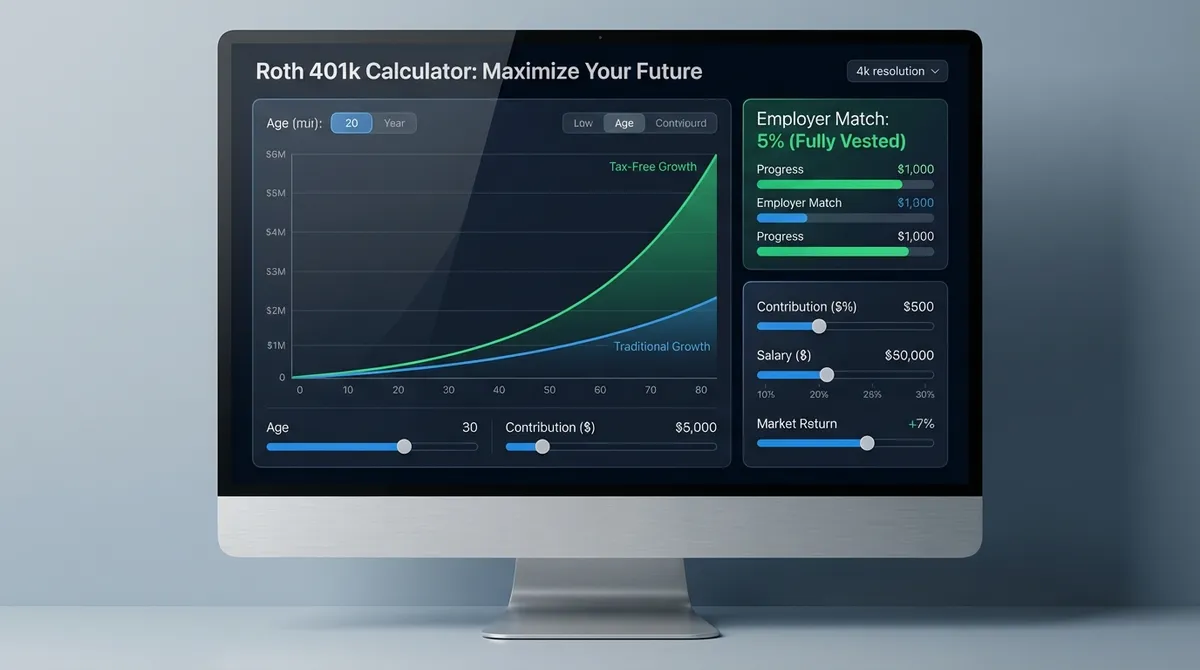
What Is a Roth 401(k) and How Does It Work?
A Roth 401(k) is a powerful retirement savings vehicle that combines the high contribution limits of a traditional 401(k) with the tax-free withdrawal benefits of a Roth IRA. Unlike traditional 401(k) contributions, which are made with pre-tax dollars, Roth 401(k) contributions are made with after-tax dollars. This means you pay taxes on the money now, but all qualified withdrawals in retirement—including both contributions and investment growth—are completely tax-free.
The key advantage of a Roth 401(k) lies in tax diversification. While no one can predict future tax rates, having tax-free income in retirement provides valuable flexibility and protection against potential tax increases. This is particularly beneficial for younger workers who are currently in lower tax brackets but expect to be in higher brackets during retirement.
2025 Roth 401(k) Contribution Limits and Rules
Understanding the current contribution limits is crucial for maximizing your retirement savings strategy. For 2025, the Roth 401(k) contribution limits are:
2025 Roth 401(k) Limits
- Employee contribution limit: $23,500
- Catch-up contribution (age 50+): +$7,500
- Total employee + employer contributions: $70,000
How to Use the Roth 401(k) Calculator
Our Roth 401(k) calculator helps you project your retirement savings based on your current age, salary, contribution percentage, employer match, and expected investment returns. Here's how to get the most accurate projections:
Enter Your Current Age and Retirement Age
Start by inputting your current age and when you plan to retire. This determines your investment timeline and when catch-up contributions become available at age 50.
Input Your Salary and Contribution Details
Enter your current annual salary and what percentage you plan to contribute. The calculator will automatically apply the 2025 contribution limits and adjust for salary increases over time.
Include Your Employer Match
Many employers offer 401(k) matching contributions. Enter your employer's match percentage and limit to see how free money accelerates your retirement growth.
Set Realistic Investment Return Expectations
Conservative investors might use 5-6%, while aggressive investors planning for long-term growth might use 8-10% based on historical market averages. Be realistic to avoid disappointment.
Understanding Your Roth 401(k) Calculator Results
Once you enter your information, the calculator provides several key metrics to help you understand your retirement readiness:
Final Balance at Retirement
This is your projected total account balance when you retire. It includes all your contributions, employer matching funds, and investment growth compounded over time.
Total Your Contributions
The sum of all Roth 401(k) contributions you made from your paycheck over your working years. This represents your actual investment principal.
Total Employer Match
Free money from your employer's matching contributions. Always contribute enough to get the full match—it's an immediate return on your investment.
Investment Growth
The power of compound interest at work—this is the earnings on your contributions and match over time. In most cases, this will be the largest portion of your final balance.
Monthly Retirement Income (4% Rule)
Using the conservative 4% withdrawal rule, this estimates how much monthly income your Roth 401(k) can generate in retirement without depleting your principal.
Key Strategies to Maximize Your Roth 401(k)
Contribute at Least Enough for Full Employer Match
If your employer offers a 401(k) match, always contribute enough to get the full match. For example, if they match 50% up to 6% of your salary, contribute at least 6%. This is free money and an immediate 50% return on your contribution.
Example: With a $75,000 salary and 6% contribution ($4,500), a 50% match gives you an additional $2,250 per year. Over 30 years at 7% return, that match alone grows to over $226,000.
Front-Load Contributions Early
Starting early gives compound interest more time to work. A 25-year-old contributing $500/month reaches $1 million by age 60 (8% return). A 35-year-old would need to contribute $1,200/month for the same result—more than double.
Take Advantage of Catch-Up Contributions
Once you turn 50, you can contribute an additional $7,500 per year (2025 limit). This helps accelerate savings in your final working years when you may have fewer expenses and higher income.
Common Roth 401(k) Mistakes to Avoid
- ✗Not contributing enough to get the full employer match: This is leaving free money on the table and missing out on an immediate return.
- ✗Cashing out when changing jobs: This triggers taxes and penalties, and worse, it resets your compound interest clock. Always roll over to a new employer's plan or an IRA.
- ✗Being too conservative with investments: Young investors should consider aggressive growth funds. While bonds feel safer, they historically underperform stocks over long periods.
- ✗Not increasing contributions with salary raises: Set up automatic contribution increases each year to maintain or grow your savings rate as your income rises.
Roth 401(k) vs Traditional 401(k): Making the Right Choice
The choice between Roth and traditional 401(k) contributions depends on your current tax bracket versus your expected tax bracket in retirement. Use our Roth 401(k) calculator to see the long-term impact of tax-free growth.
| Factor | Roth 401(k) | Traditional 401(k) |
|---|---|---|
| Tax Treatment | After-tax contributions, tax-free withdrawals | Pre-tax contributions, taxable withdrawals |
| Best For | Younger workers, lower current tax brackets | Peak earning years, higher current tax brackets |
| Required Minimum Distributions | Yes, starting at age 73 | Yes, starting at age 73 |
| Early Withdrawals | Contributions can be withdrawn tax-free | Taxes and 10% penalty before age 59½ |
Real-World Example: Maximizing Your Roth 401(k)
Sarah, Age 30: Earning $65,000/year and contributing 10% ($6,500/year) to her Roth 401(k) with a 50% employer match up to 6% of salary.
- Her contribution: $6,500/year
- Employer match: $1,950/year (50% of first 6% = $1,950/year)
- Total annual contribution: $8,450
- Projected balance at age 65 (7% return): $1,425,000
Key Insight: Over $950,000 of Sarah's final balance comes from compound growth—far exceeding her actual contributions, demonstrating why starting early is so powerful.
Bottom Line
A Roth 401(k) is one of the most powerful tools for building tax-free retirement wealth. Use our calculator to project your specific situation, then maximize your contributions to take full advantage of compound growth and employer matching. The earlier you start and the more consistently you contribute, the more secure your retirement will be.
Roth 401(k) vs. Roth IRA: Which Should You Prioritize?
While both accounts offer tax-free growth and withdrawals, they have distinct rules and benefits. Often, the best strategy is to use both, but the order of operations matters.
Roth 401(k) Advantages
- • Higher Limits: Contribution limit is much higher ($23,500 vs $7,000 for IRA).
- • No Income Limits: High earners can contribute regardless of income level.
- • Employer Match: The biggest advantage—free money from your employer.
- • Loan Options: Many plans allow you to borrow from your balance.
Roth IRA Advantages
- • More Investment Choices: Access to stocks, ETFs, bonds, vs limited 401(k) menu.
- • Withdrawal Flexibility: Contributions (not earnings) can be withdrawn anytime tax-free and penalty-free.
- • No RMDs: No Required Minimum Distributions during your lifetime.
Understanding the "5-Year Rule" for Withdrawals
To withdraw earnings from your Roth 401(k) tax-free, you must meet two conditions: you must be at least 59½ years old, AND the account must have been open for at least 5 years. This 5-year clock starts on January 1st of the year you made your first contribution.
Important Note: If you roll your Roth 401(k) into a Roth IRA, the Roth IRA has its own 5-year clock. However, if you roll it into an existing Roth IRA that has already met the 5-year requirement, the rolled-over funds immediately satisfy the rule.
Frequently Asked Questions (FAQ)
Does the employer match go into the Roth or Traditional bucket?
Historically, employer matching contributions always went into a pre-tax (Traditional) account, meaning you would owe taxes on that portion upon withdrawal. However, under the SECURE Act 2.0, employers can now allow employees to elect to receive matching contributions in their Roth account. If you choose this, the match is taxable income to you in the year you receive it.
Can I switch from Traditional to Roth 401(k)?
Yes, many plans allow for an "In-Plan Roth Conversion." This allows you to convert existing pre-tax balances to Roth. However, be prepared: you will owe ordinary income tax on the entire amount you convert in that tax year. This is a strategic move best done in low-income years.
What happens to my Roth 401(k) if I leave my job?
You have several options: leave it there (if the balance is over $5,000), roll it into your new employer's Roth 401(k) plan, or roll it into a Roth IRA. Rolling to a Roth IRA is often preferred because it opens up more investment options and eliminates RMDs (though 2024 rules eliminated RMDs for Roth 401(k)s as well).
Is a Roth 401(k) worth it if I am in a high tax bracket?
It can be. While the conventional wisdom says "pre-tax for high earners," tax diversification is valuable. Having a bucket of tax-free money in retirement allows you to manage your taxable income precisely (e.g., keeping it below Medicare surcharge thresholds). Many high earners split their contributions 50/50 between Traditional and Roth for this reason.