Complete Guide: Roth Conversion Calculator — Roth IRA Conversion Tax Calculator & Strategy Tool (2025)
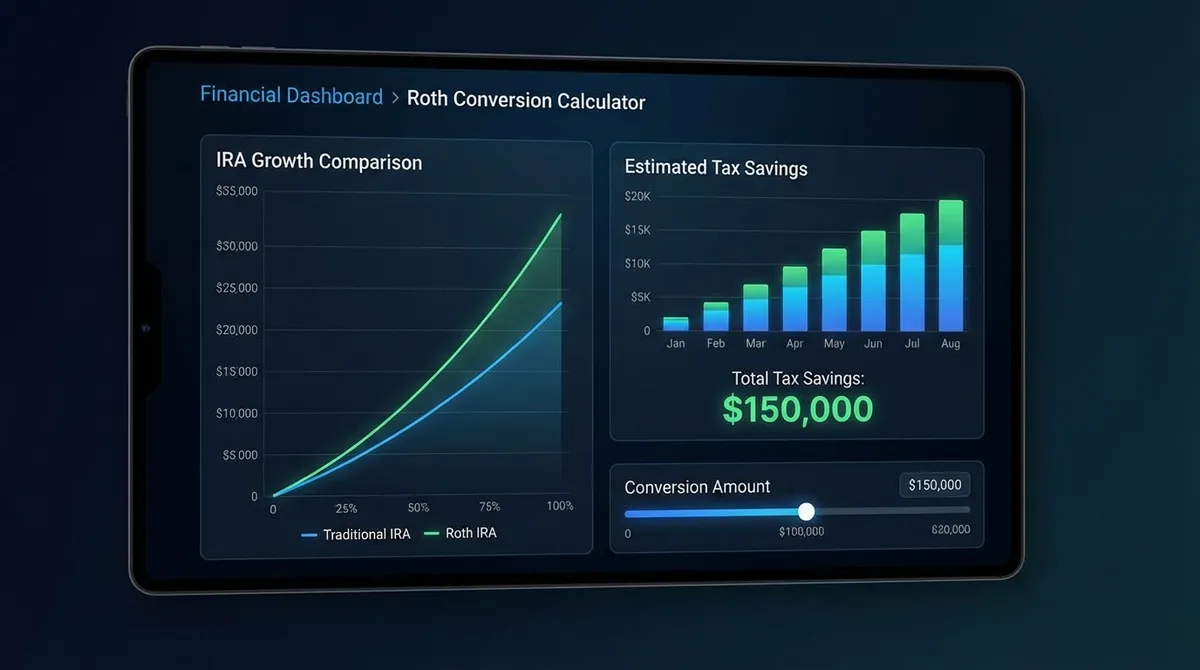
What Is a Roth IRA Conversion and How Does It Transform Your Retirement?
A Roth IRA conversion is the strategic process of transferring funds from a traditional tax-deferred retirement account—such as a Traditional IRA, SEP-IRA, or 401(k)—into a Roth IRA. This powerful financial move fundamentally changes your retirement tax situation: you pay income taxes on the converted amount today, but gain the incredible benefit of tax-free growth and tax-free withdrawals for the rest of your life.
Think of it as choosing to pay your tax bill now rather than later. Traditional retirement accounts are like tax-deferred seeds—you plant pre-tax money, it grows for decades, but the IRS waits patiently to harvest their share when you withdraw in retirement. A Roth IRA is more like after-tax, genetically-modified super seeds—they cost more upfront, but the entire harvest (growth plus original seed) is 100% yours forever.
Key Statistic: A $50,000 Roth conversion at age 45, earning 7% annually over 20 years, grows to $193,484—all completely tax-free. If left in a Traditional IRA and taxed at 24% in retirement, that same $193,484 would only net you $147,048 after taxes. The Roth advantage? $46,436 more in your pocket, not the IRS's.
How Roth Conversions Work: The Mechanics and Math
When you initiate a Roth conversion, you're essentially telling the IRS: "I want to accelerate my tax payment." The process is straightforward: you transfer assets from your traditional account to a Roth account, and the entire converted amount becomes taxable income for that year.
Here's exactly what happens step-by-step: First, you identify which traditional retirement accounts you want to convert from. You can convert from Traditional IRAs, SEP-IRAs, SIMPLE IRAs (after 2-year participation period), 401(k)s from former employers, and other pre-tax retirement accounts. You can convert any amount—you're not required to convert the entire balance.
The Conversion Formula:
Example: $50,000 × (22% + 5%) = $13,500 in taxes
You have three ways to execute the conversion: (1) A direct trustee-to-trustee transfer (most common), where your current custodian sends funds directly to your Roth IRA custodian. (2) A 60-day rollover, where you take a distribution as a check and deposit it into your Roth IRA within 60 days (risky—miss the deadline and you'll owe penalties). (3) A same-trustee transfer, where your financial institution moves funds between accounts internally.
The IRS treats conversions as ordinary income, so the converted amount is added to your other income for the year. This can potentially push you into a higher tax bracket—a crucial consideration that makes strategic timing essential. The tax bill comes due when you file your tax return for the conversion year, though most advisors recommend paying the tax from non-retirement accounts to maximize the Roth benefit.
The Critical 5-Year Rules Every Converter Must Know
The five-year rule is perhaps the most misunderstood aspect of Roth IRAs, and it actually consists of three separate rules that can trap unwary investors. Each rule applies differently to contributions, conversions, and earnings.
The 5-Year Rule for Earnings
This rule applies to the earnings on your contributions. Your Roth IRA must be open for at least five tax years before you can withdraw earnings tax-free. The clock starts on January 1 of the year you make your first Roth IRA contribution—even if that contribution is made in April of the following year for the prior tax year. Once met, this rule is satisfied forever, even for future Roth IRAs.
The 5-Year Rule for Conversions (CRITICAL)
Here's where most people get tripped up: Each conversion has its own separate 5-year clock. If you convert funds at age 56 and withdraw them at age 59, you'll pay a 10% penalty even though you're over 59½! The penalty applies to the converted amount, not just earnings. After age 59½, you can withdraw converted amounts penalty-free even before 5 years, but the earnings portion faces the 5-year earnings rule.
Inherited Roth IRAs
Beneficiaries must check whether the original account owner satisfied the 5-year earnings rule. If not, earnings withdrawals may be taxable. However, contributions can always be withdrawn tax-free, and the 10% penalty never applies to inherited accounts due to death.
Critical Timing Example: If you're 57 years old and convert $50,000, you cannot touch that money until you're 62 without penalty (five full tax years must pass). If you wait until 60 to convert, you can't access it penalty-free until 65—even though you're over 59½! This is why timing conversions before age 59.5 requires careful planning.
Real-World Examples: Conversion Strategies in Action
Sarah & Mike: The Early Retirement Conversion Ladder
Sarah, 58, and Mike, 60, retire early with $800,000 in traditional IRAs and $200,000 in taxable accounts. They live off taxable account dividends ($30,000/year) while converting $40,000 annually to Roth IRAs, staying in the 12% tax bracket. Over 8 years before RMDs begin, they convert $320,000, paying $38,400 in taxes. At 7% growth, this Roth account grows to $550,000 by age 70—completely tax-free, reducing their future RMDs and saving an estimated $132,000 in lifetime taxes.
David: The Market Crash Opportunist
David, 45, has $100,000 in a Traditional IRA. During a market correction, his balance drops to $65,000. He converts the entire amount, paying $15,600 in tax (24% bracket) instead of the $24,000 he would have paid at $100,000. The market recovers over 20 years, growing his Roth to $252,000—all tax-free. By converting at the bottom, David saved $8,400 in taxes on the same eventual portfolio value.
Linda: The Inheritance Planner
Linda, 70, has $500,000 in a Traditional IRA and two children in their 40s who earn high incomes. She converts $50,000 annually for 5 years, paying $12,000/year in taxes. Her Roth grows to $350,000, which passes tax-free to her children. Since they would have inherited the traditional IRA and faced 32% taxes on withdrawals plus required distributions, Linda's conversion saves her family approximately $80,000 in taxes and gives them ultimate flexibility.
Deadly Roth Conversion Mistakes That Cost Thousands
Mistake #1: Converting During Peak Earnings
Converting in your highest income year pushes you into a higher tax bracket. Spread conversions over lower-income years.
Mistake #2: Paying Tax from the IRA
Using converted funds to pay taxes reduces your Roth balance and triggers penalties if under 59½. Always pay from taxable accounts.
Mistake #3: Ignoring IRMAA Thresholds
A large conversion can increase Medicare Part B premiums by thousands annually. Stay below IRMAA thresholds.
Mistake #4: Forgetting the 5-Year Rule
Withdrawing converted funds before 5 years face penalties. Plan your cash needs before converting.
Mistake #5: Converting Everything at Once
This slams you into the highest tax bracket. Convert gradually over multiple years for lower effective rates.
Mistake #6: Ignoring Tax Diversification
Maintaining both traditional and Roth accounts provides flexibility. Don't convert everything—keep both buckets.
Frequently Asked Questions (FAQ)
Can I undo a Roth conversion if the market drops?
No. Since the Tax Cuts and Jobs Act of 2017, you can no longer "recharacterize" or undo a Roth conversion. Once you move the money, the tax bill is locked in. This makes careful planning and certainty essential before executing a transfer.
Is there an income limit for Roth conversions?
No. Unlike Roth IRA contributions, which have strict income limits, anyone can perform a Roth conversion regardless of how much money they earn. This "loophole" is what enables the high-income "Backdoor Roth" strategy.
Does a conversion satisfy my RMD for the year?
No. You must take your Required Minimum Distribution (RMD) before converting any funds. You cannot convert the RMD itself. The IRS requires the first dollars out of the account to satisfy the RMD. Only after that can you convert remaining funds.
How do I pay the tax on the conversion?
You should ideally pay the tax with cash from a checking or savings account. If you withhold taxes from the conversion amount itself, you are 1) reducing the amount growing tax-free and 2) triggering a 10% early withdrawal penalty on the withheld portion if you are under 59½.