Complete Guide: Roth IRA Calculator for Tax-Free Retirement Growth
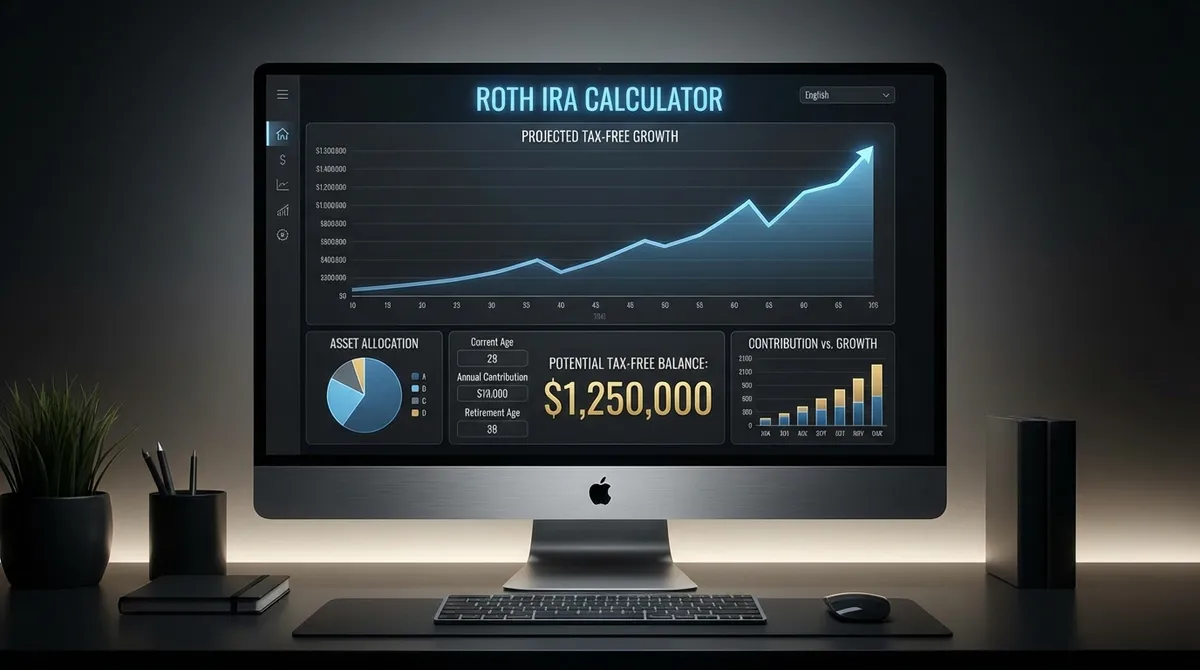
A Roth IRA is one of the most powerful retirement savings tools available to American investors. Unlike traditional retirement accounts, Roth IRAs offer tax-free growth and tax-free withdrawals in retirement, making them an essential component of any comprehensive retirement strategy. Our Roth IRA calculator helps you project your potential tax-free retirement wealth based on your contribution strategy, investment timeline, and expected returns.
Understanding Roth IRA Tax Advantages
The fundamental difference between Roth IRAs and traditional retirement accounts lies in when you pay taxes. With a Roth IRA, you contribute after-tax dollars today but enjoy completely tax-free withdrawals in retirement. This creates a powerful long-term advantage, especially for younger investors or those who expect to be in a higher tax bracket during retirement.
Key Roth IRA Benefits:
- Tax-free growth: Your investments grow without annual tax drag on dividends or capital gains
- Tax-free withdrawals: Qualified distributions in retirement are 100% tax-free
- No required minimum distributions: Unlike traditional IRAs, Roth IRAs don't force withdrawals at age 73 (see our RMD calculator)
- Flexibility: You can withdraw contributions anytime without penalty or taxes
- Estate planning benefits: Roth IRAs can be passed to heirs with continued tax-free growth potential
2025 Roth IRA Contribution Limits and Income Restrictions
The IRS sets annual contribution limits for Roth IRAs, which are periodically adjusted for inflation. For 2025, the standard contribution limit is $7,000 for individuals under age 50. Investors aged 50 and older can contribute an additional $1,000 as a "catch-up" contribution, bringing their total limit to $8,000. For more details, see the IRS Roth IRA guidelines.
However, Roth IRA contributions are subject to income limitations:
- Single filers: Full contributions allowed with modified adjusted gross income (MAGI) under $150,000; phased out between $150,000-$165,000
- Married filing jointly: Full contributions allowed with MAGI under $236,000; phased out between $236,000-$246,000
- Married filing separately: Extremely low income limits apply, generally making direct Roth IRA contributions difficult
Pro Tip: If your income exceeds these limits, you may still be able to contribute through a "backdoor Roth IRA" strategy—making a non-deductible contribution to a traditional IRA and then converting it to a Roth IRA.
How Roth IRA Growth Works: The Power of Tax-Free Compounding
The magic of Roth IRAs comes from compound growth without tax friction. In a taxable investment account, you pay taxes on dividends and capital gains annually, which reduces your effective return. In a Roth IRA, every dollar of growth stays in your account, compounding on itself year after year.
This difference becomes dramatic over long periods:
- At a 7% annual return, $500 monthly contributions grow to over $1,000,000 in 35 years
- The same contributions in a taxable account (assuming 22% tax rate) would grow to approximately $750,000-$800,000
- The tax-free advantage delivers an extra $200,000-$250,000 in retirement wealth
- All Roth IRA withdrawals in retirement are completely tax-free, while taxable account withdrawals trigger capital gains taxes
Roth IRA Withdrawal Rules and Benefits
One of the most misunderstood aspects of Roth IRAs is the withdrawal flexibility they offer. Unlike traditional retirement accounts, Roth IRAs provide unique access to your money:
Contribution Withdrawals:
You can withdraw any amount you've contributed to your Roth IRA at any time, for any reason, without taxes or penalties. This makes Roth IRAs function as both retirement accounts and emergency funds.
Earnings Withdrawals (Qualified Distributions):
To withdraw earnings tax-free and penalty-free, you must:
- Be at least 59½ years old, AND
- Have held the Roth IRA for at least 5 years
Exceptions to Early Withdrawal Penalties:
You may avoid the 10% early withdrawal penalty on earnings (though you'll still owe income tax) for:
- First-time home purchase (up to $10,000 lifetime limit)
- Qualified education expenses
- Disability
- Unreimbursed medical expenses exceeding 7.5% of AGI
- Health insurance premiums during unemployment
Optimizing Your Roth IRA Strategy
Start Early and Contribute Consistently
The earlier you start contributing to a Roth IRA, the more time your investments have to compound tax-free. Even small contributions in your 20s can grow to substantial sums by retirement. For example:
- $200/month starting at age 25 = approximately $720,000 at age 65 (7% return)
- $400/month starting at age 35 = approximately $600,000 at age 65 (7% return)
- The earlier starter contributes less total money but ends up with more
Maximize Employer Match First
If your employer offers a 401(k) match, contribute enough to get the full match before prioritizing Roth IRA contributions. Free employer matching money typically outweighs Roth IRA tax benefits.
Consider Roth Conversion Ladders
For early retirees, Roth IRA conversion ladders can provide tax-free income before age 59½. This involves converting traditional IRA funds to Roth IRAs over several years to create a pipeline of accessible funds.
Asset Location Strategy
Place your highest-growth investments in your Roth IRA to maximize tax-free growth. Investments that generate significant capital gains or high dividend yields are ideal for Roth IRAs.
Common Roth IRA Mistakes to Avoid
- Exceeding income limits: Contributing directly when your income exceeds IRS limits can result in penalties
- Over-contributing: Contributing more than the annual limit triggers a 6% excess contribution penalty
- Missing the deadline: Contributions for a given tax year must be made by April 15th of the following year
- Cashing out during market downturns: Withdrawing during market lows locks in losses and reduces long-term growth potential
- Not diversifying: Concentrating all Roth IRA investments in a single stock or sector increases risk
- Ignoring fees: High investment fees can significantly reduce your long-term returns. Consider using a traditional IRA calculator to compare tax impacts.
Roth IRA vs Traditional IRA: Which Is Right for You?
The choice between Roth and traditional IRA depends on your current tax situation and future expectations:
Choose Roth IRA If:
- You expect to be in a higher tax bracket in retirement
- You're young and have decades until retirement
- You want tax-free income flexibility in retirement
- You don't need the immediate tax deduction
- You want to avoid required minimum distributions
Choose Traditional IRA If:
- You need the immediate tax deduction
- You expect to be in a lower tax bracket in retirement
- You're in your peak earning years with high current tax rates
- You want to reduce your current taxable income
- You don't mind required minimum distributions
How to Use Our Roth IRA Calculator
- Enter your current age and planned retirement age: This determines your investment timeline
- Input your initial contribution: If you already have a Roth IRA, enter the current balance
- Set your monthly contribution amount: The calculator will validate against 2025 contribution limits
- Adjust your expected annual return: We recommend 7-8% for diversified stock portfolios
- Enter your tax rates: Current rate affects taxable account growth; retirement rate shows the tax-free advantage
- Toggle age 50+ catch-up contributions: Automatically adjusts contribution limits if applicable
- Review your results: See projected balances, tax savings, and growth charts
Important Note: This calculator provides estimates based on the inputs you provide. Actual investment returns will vary, and it's important to review your Roth IRA strategy regularly as market conditions, tax laws, and your personal circumstances change.
Maximize Your Roth IRA Potential
The combination of tax-free growth, flexible withdrawals, and no required minimum distributions makes Roth IRAs a cornerstone of modern retirement planning. Start early, contribute consistently, and let compound interest work in your favor.
Next Steps to Open or Optimize Your Roth IRA
- Check your eligibility: Confirm your income is within IRS limits for direct Roth IRA contributions
- Choose a provider: Compare fees, investment options, and features at major brokerages
- Start contributing: Set up automatic monthly contributions to maximize the power of dollar-cost averaging
- Invest appropriately: Choose diversified investments aligned with your risk tolerance and timeline
- Monitor and adjust: Review your strategy annually and adjust contributions or investments as needed
- Consider conversions: Evaluate Roth conversion opportunities during low-income years
Frequently Asked Questions (FAQ)
Can I lose money in a Roth IRA?
Yes. A Roth IRA is just an empty "bucket" or account type. The risk depends entirely on what investments you put inside that bucket (stocks, bonds, mutual funds). If the market goes down, your account balance will decrease. However, historically, diversified portfolios have recovered and grown over the long term.
Does a Roth IRA reduce my taxable income today?
No. Contributions are made with "after-tax" dollars, meaning you receive no tax deduction for the year you contribute. The benefit is entirely "back-loaded" in the form of tax-free withdrawals in retirement.
Can I open a Roth IRA for my child?
Yes, as long as the child has "earned income" (wages from a job, W-2 or 1099). This is often called a Custodial Roth IRA. You cannot contribute more than they earned. It is an incredibly powerful way to build generational wealth due to the massive compounding timeframe. Even small amounts can reduce reliance on Social Security later.
What is the "5-Year Rule"?
There are actually two 5-year rules. 1) You cannot withdraw earnings tax-free until 5 years after your first contribution to any Roth IRA. 2) For Roth conversions, each conversion has its own 5-year waiting period before you can withdraw the principal penalty-free (if under 59½).
Can I contribute to both a 401(k) and a Roth IRA?
Absolutely. In fact, it is a recommended strategy. Security comes from tax diversification: a 401(k) gives you tax-deferred growth (better if taxes go down), while a Roth IRA gives you tax-free growth (better if taxes go up). Having both gives you flexibility in retirement.