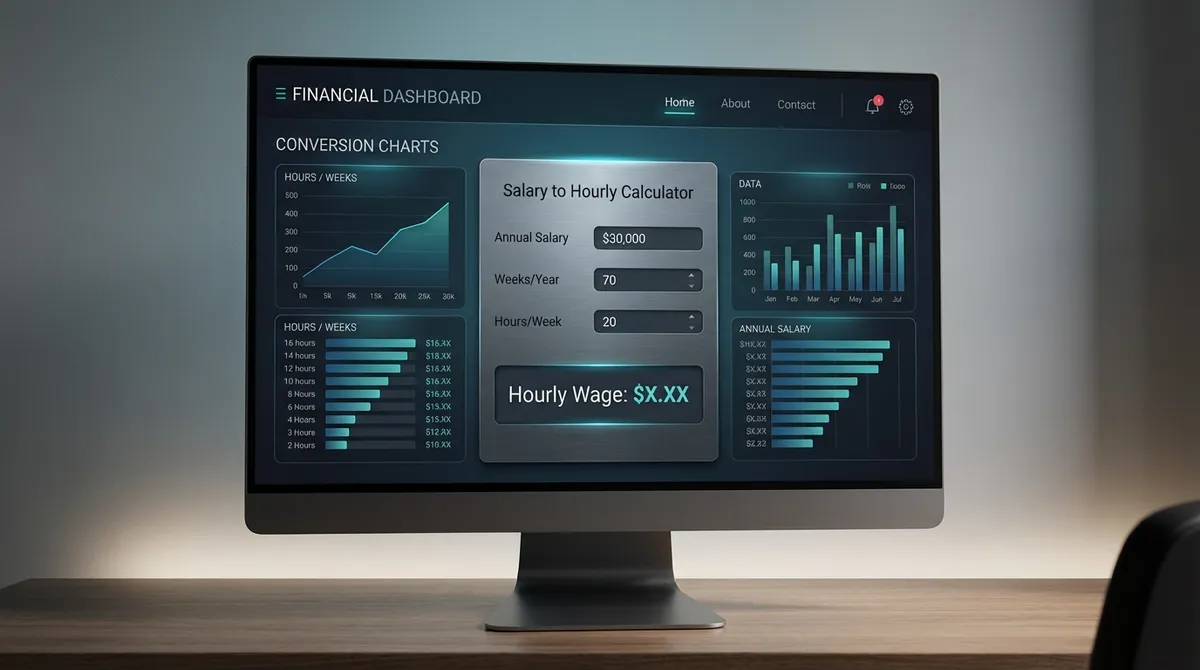
The Hidden Mathematics of Your Paycheck
Most people see their salary as a single big number—$65,000 or $80,000 a year. But this number hides the reality of what your time is actually worth. When you break it down, your hourly wage is the true metric of your financial life.
Think about it: A job paying $100,000 that requires 60-hour weeks actually pays less per hour than a $70,000 job that strictly adheres to 40 hours. Our Salary to Hourly Calculator cuts through the noise to show you exactly what you're earning for every hour of your life you trade for work.
How to Calculate Hourly Wage from Salary
The standard formula is deceptively simple, but understanding it is key to accurate financial planning. You can also reverse this calculation using our Hourly to Salary Calculator if you're considering a switch in pay structure.
For a standard 40-hour work week, you work 2,080 hours a year (40 × 52). So, you simply divide your salary by 2,080.
- $50,000 / 2,080 = $24.04/hour
- $75,000 / 2,080 = $36.06/hour
- $100,000 / 2,080 = $48.08/hour
However, life rarely follows the "standard" model. Unpaid overtime, which can be analyzed with our Overtime Calculator, paid time off (PTO), and benefits packages can skew these numbers dramatically.
The "Effective Hourly Rate": Why Benefits Matter
Your base salary is just one part of the equation. To understand your true compensation, you need to calculate your Effective Hourly Rate. This accounts for two invisible factors:
- Total Compensation Value: This includes health insurance premiums paid by your employer, 401(k) matches, and bonuses. These are real dollars in your pocket.
- Actual Hours Worked: If you get 3 weeks of paid vacation, you are getting paid for 52 weeks but only working 49. This increases your earnings per actual hour worked. This concept is crucial when estimating your total Annual Income.
Example: Sarah earns $80,000. She gets $10,000 in benefits and 15 days (3 weeks) of PTO. You can compare this against standard take-home pay using a Paycheck Calculator.
- Standard Rate: $80,000 / 2,080 hours = $38.46/hour
- Total Comp ($90,000) / Actual Hours (1,960) = $45.92/hour
By factoring in benefits and PTO, Sarah realizes she is actually earning nearly $7.50 more per hour than the sticker price suggests.
The "Ghost Hours": Unpaid Overtime Risks
If you are a salaried employee, "ghost hours" are the silent killer of your effective hourly wage. These are the hours you spend checking email at night, commuting to mandatory events, or working through lunch.
The 10-Hour Trap
Adding just 10 hours of work per week (a 50-hour week instead of 40) reduces your hourly rate by exactly 20%. It is mathematically identical to taking a 20% pay cut while working standard hours.
- The "On-Call" Expectation: If you are expected to respond to Slack messages within 15 minutes at all times, are you ever truly "off the clock"?
- Travel Time: Business travel often involves 12+ hour days but is rarely compensated with extra time off.
Salary vs. Hourly: Pros and Cons
| Feature | Salaried (Exempt) | Hourly (Non-Exempt) |
|---|---|---|
| Pay Consistency | Guaranteed same paycheck every cycle. | Fluctuates based on hours worked. See our Gross Pay Calculator. |
| Overtime | Usually none (work until done). | 1.5x pay for hours over 40. |
| Flexibility | Often higher (run errands, flexible start). | Often strict (clock in/out). |
The Psychological Difference
There is a profound psychological shift when moving between these models. Hourly workers tend to view time as inventory—every hour has a price tag, and "free" work feels like theft. Salaried workers often view time as a task-based resource—the goal is to "get the job done," regardless of how long it takes. This can lead to "time blindness," where salaried employees drastically devalue their own free time because there is no immediate financial penalty for working late.
Case Studies: The Trap of Overworking
The biggest danger for salaried employees is "lifestyle creep" in hours worked. Let's look at two managers, Alex and Jordan, who both earn $95,000.
Alex (The "Standard" Week)
- Salary: $95,000
- Hours: 40/week
- Hourly Rate: $45.67
Jordan (The Grinder)
- Salary: $95,000
- Hours: 55/week
- Hourly Rate: $33.22
By working 15 extra hours a week, Jordan has effectively taken a 27% pay cut per hour compared to Alex. If you find yourself in Jordan's shoes, it might be time to renegotiate or set stricter boundaries.
How to Use This Data for Negotiation
Knowing your true hourly rate is a superpower during job offers or performance reviews. It allows you to make apples-to-apples comparisons between offers that might look very different on the surface.
Scenario 1: The "Unlimited PTO" Trap
Offer: $100k with "unlimited PTO."
Reality: Studies show people with unlimited PTO take fewer days off than those with fixed accrual. Without a guaranteed payout for unused days, your effective hourly rate might actually be lower than a $95k job with 3 weeks of fixed vacation.
Scenario 2: The Commute Calculation
Offer: A $10k raise ($105/day pre-tax) requires a 1-hour commute each way.
Reality: That's 10 hours/week of unpaid labor. If you earn $50/hour, you are "spending" $500/week (or $26k/year) of your time value to get that $10k raise. It's a net loss.
Negotiation Scripts
If offered a lower salary with "great benefits":
"I appreciate the benefits package. However, when I calculate the effective hourly rate based on the expected 50-hour work week, it comes out to roughly $35/hour. My target is $45/hour based on market value. Can we bridge this gap with a higher base salary or a performance bonus structure? I've referenced data from the Bureau of Labor Statistics to benchmark this role."
If switching from Contractor to Full-Time:
"I understand the hourly rate looks lower on paper, but I've factored in the $15,000 value of the health & 401k package. That brings the effective compensation to a competitive level, so I am comfortable with this base salary."
Common Calculation Mistakes
1. Forgetting the Leap Year
While 2,080 hours is the standard, some years have 261 or even 262 workdays. For hourly workers, this means an "extra" paycheck. For salaried workers, it means your daily rate slightly dilutes.
2. Ignoring Unpaid Lunch
If you are at the office from 9 to 6 with a mandatory 1-hour unpaid lunch, your "day" is 9 hours long, even if you only work 8. That unpaid hour restricts your freedom and should be factored into your personal "time cost" calculation.
Glossary of Pay Terms
- Exempt Employee
- Employees who are exempt from overtime laws (FLSA). They are paid a salary regardless of hours worked. Most professional, executive, and administrative roles fall here.
- Non-Exempt Employee
- Employees entitled to minimum wage and overtime pay. Even if paid a "salary," they must track hours and be paid 1.5x for hours over 40.
- Gross vs. Net Pay
- Gross is the big number on the offer letter. Net is what actually hits your bank account after taxes and deductions. Our calculator works with Gross numbers for standard comparison.
Frequently Asked Questions (FAQ)
Why do some years have 27 paychecks?
If you are paid bi-weekly (every 14 days), that equals 364 days a year. Since a year has 365 days (or 366), those extra days accumulate. Approximately every 11 years, the calendar aligns such that there are 27 pay periods instead of 26.
How do I calculate a daily rate?
Divide your annual salary by 260 (the standard number of working days in a year: 52 weeks × 5 days). For example, $52,000 / 260 = $200 per day.
Is a higher hourly rate always better?
Not necessarily. Contract roles often pay 20-30% more per hour than full-time roles to compensate for the lack of benefits (health insurance, PTO, payroll taxes). A $50/hour contract might net you less than a $40/hour full-time job with full benefits.
How do taxes affect my hourly rate?
Significantly. A \$50/hour rate might actually be \$35/hour after federal, state, and FICA taxes. For a deeper understanding, check our Take-Home Pay Calculator to see your real "take-home" hourly wage.
Freelancer Rule of Thumb
If you are switching from a salaried job to freelancing, you generally need to charge 1.5x to 2x your salaried hourly equivalent to maintain the same standard of living. This covers self-employment, health insurance, and unpaid administrative time.
The "Value of Time" Concept
Beyond money, your hourly rate helps you make life decisions. If you earn \$50/hour, is it worth spending an hour fighting with customer service for a \$20 refund? Probably not. It changes how you value your free time.
How does a bonus affect my hourly rate?
Treat a bonus as "retroactive pay." If you get a $5,000 bonus at year-end, divide that by your 2,080 hours. That means you effectively earned an extra $2.40 for every single hour you worked that year.
Key Takeaway
Your time is a finite resource. Use this calculator not just to convert numbers, but to evaluate the true exchange rate of your life energy. Often, a "lower" salary with better benefits and fewer hours yields a richer life.