Complete Guide: Sales Tax Calculator 2025: State & Local Tax Estimator
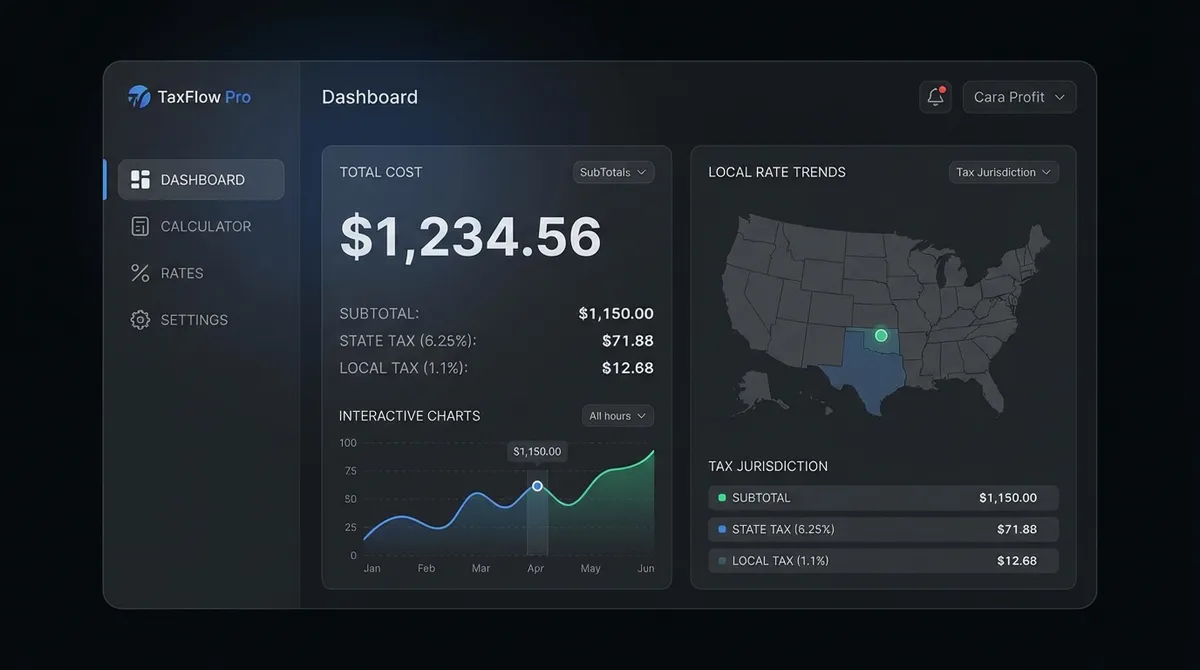
Sales tax is one of the most common consumption taxes in the United States, yet calculating accurate totals can be surprisingly complex. With over 13,000 distinct tax jurisdictions across the country, the final price you pay at the register often includes a mix of state, county, city, and special district taxes. This complexity often rivals that of understanding your Income Tax liability.
This 2025 Sales Tax Calculator is designed to simplify these calculations. Whether you are a consumer trying to budget for a large purchase or a small business owner needing to apply the correct tax rate, our tool provides instant, accurate results for all 50 states. It's often helpful to compare sales tax burdens against other levies using a Property Tax Calculator to get a full picture of local taxation.
How to Calculate Sales Tax Manually
Calculating sales tax requires two key pieces of information: the price of the item and the combined sales tax rate for your specific location.
The Sales Tax Formula:
Tax Amount = Item Price × (Tax Rate ÷ 100)
Total Cost = Item Price + Tax Amount
Example: You are buying a laptop for $1,000 in a city with an 8.5% sales tax rate.
- Step 1: Convert the percentage to a decimal: 8.5% becomes 0.085.
- Step 2: Multiply the price: $1,000 × 0.085 = $85 (Tax Amount).
- Step 3: Add to the original price: $1,000 + $85 = $1,085 (Total).
Reverse Sales Tax Calculation
Sometimes you know the total amount paid but need to find the original pre-tax price. This is common for expense reporting or business accounting.
The Reverse Sales Tax Formula:
Pre-Tax Price = Total Paid ÷ (1 + (Tax Rate ÷ 100))
2025 State Sales Tax Rates
Below is a reference table for the base state sales tax rates. Remember that local municipalities often add their own taxes on top of these state rates. For a more comprehensive look at state-level taxation, check our State Income Tax Calculator.
| State | Base Tax Rate |
|---|---|
| Alabama | 4.00% |
| Alaska | 0.00% |
| Arizona | 5.60% |
| Arkansas | 6.50% |
| California | 7.25% |
| Colorado | 2.90% |
| Connecticut | 6.35% |
| Delaware | 0.00% |
| Florida | 6.00% |
| Georgia | 4.00% |
| Hawaii | 4.00% |
| Idaho | 6.00% |
| Illinois | 6.25% |
| Indiana | 7.00% |
| Iowa | 6.00% |
| Kansas | 6.50% |
| Kentucky | 6.00% |
| Louisiana | 4.45% |
| Maine | 5.50% |
| Maryland | 6.00% |
| Massachusetts | 6.25% |
| Michigan | 6.00% |
| Minnesota | 6.875% |
| Mississippi | 7.00% |
| Missouri | 4.225% |
| Montana | 0.00% |
| Nebraska | 5.50% |
| Nevada | 6.85% |
| New Hampshire | 0.00% |
| New Jersey | 6.625% |
| New Mexico | 5.125% |
| New York | 4.00% |
| North Carolina | 4.75% |
| North Dakota | 5.00% |
| Ohio | 5.75% |
| Oklahoma | 4.50% |
| Oregon | 0.00% |
| Pennsylvania | 6.00% |
| Rhode Island | 7.00% |
| South Carolina | 6.00% |
| South Dakota | 4.50% |
| Tennessee | 7.00% |
| Texas | 6.25% |
| Utah | 4.85% |
| Vermont | 6.00% |
| Virginia | 5.30% |
| Washington | 6.50% |
| West Virginia | 6.00% |
| Wisconsin | 5.00% |
| Wyoming | 4.00% |
Understanding Tax Exemptions
Not everything you buy is subject to sales tax. Governments often exempt essential goods to reduce the financial burden on low-income households. However, these rules are notoriously inconsistent.
Groceries
Most states (like California, Texas, and Florida) exempt "unprepared food" purchased at grocery stores. However, prepared hot foods (like a rotisserie chicken) are taxable. Some states, like Alabama and Mississippi, still fully tax groceries. Understanding these nuances can help you better estimate your overall tax burden, similar to using a Tax Bracket Calculator for income.
Prescription Drugs
Nearly all states exempt prescription medications. Over-the-counter (OTC) drugs like aspirin are usually taxable, although some states (like Illinois) tax them at a reduced rate.
Clothing
This is a mixed bag. Pennsylvania, Minnesota, New Jersey, and Vermont generally exempt clothing. New York exempts items under $110. Massachusetts exempts items under $175. In most other states, clothes are fully taxable.
Digital Goods
Downloads (e-books, music, software) are taxable in about 30 states. Streaming services (Netflix, Spotify) are increasingly being taxed under new "digital services" laws.
Destination-Based vs. Origin-Based Sourcing
For online sellers, knowing which tax rate to charge is critical.
- Destination-Based (Most States): You charge the tax rate of the buyer's address (where the item is delivered). If you ship to a customer in a ZIP code with 8% tax, you collect 8%.
- Origin-Based (A Few States): You charge the tax rate of your business's location (where the item ships from). Examples include Arizona, Ohio, Pennsylvania, Tennessee, Texas, Utah, and Virginia. This distinction is critical for business deductions, which can be explored with our Tax Deduction Calculator.
Online vs. In-Store Purchases
Since the 2018 South Dakota v. Wayfair Supreme Court ruling, most online retailers are required to collect sales tax based on the shipping destination.
- If you buy online, the tax rate is usually determined by where the package is delivered, not where the seller is located.
- Large marketplaces (Amazon, eBay, Etsy) automatically collect and remit these taxes for you.
- If an online seller does not collect sales tax, you may legally owe "Use Tax" to your state, reported on your annual tax return.
The New Frontier: Sales Tax on Digital Goods
In the past, sales tax applied mostly to physical items you could touch—clothes, electronics, cars. Today, the economy is digital, and tax laws are catching up.
What is Taxable?
- Streaming Services: Netflix, Spotify, and Hulu are now taxed in over 30 states (often called "Netflix Taxes").
- E-Books and Software: Downloads are frequently treated as tangible personal property.
- SaaS (Software as a Service): Business software subscriptions are increasingly taxable.
What is Typically Exempt?
- Custom Software: Software written specifically for one client is often treated as a professional service (exempt).
- Digital Advertising: Ads on Google or Facebook are generally not subject to sales tax (though Maryland has attempted a specific digital ads tax).
Sales Tax Holidays: Maximizing Savings
Many states offer annual "Sales Tax Holidays"—specific weekends where certain items are tax-free. These events typically coincide with the back-to-school season (August) or severe weather preparedness months.
Common Tax-Free Items
- Clothing and footwear under $100
- School supplies (backpacks, binders)
- Computers and tablets (personal use)
- Energy Star appliances
Shopping Strategy
If you plan to buy a laptop or major appliance, checking your state's tax holiday calendar can save you $50–$100 instantly. Unlike a coupon, this discount applies to the final price after all other store discounts.
Sales Tax vs. Value-Added Tax (VAT)
If you have traveled to Europe, Canada, or Asia, you have likely encountered VAT. While it feels similar to sales tax (a percentage added at checkout), the underlying mechanics are radically different.
| Feature | US Sales Tax | Value-Added Tax (VAT) |
|---|---|---|
| When is it collected? | Only at the final sale to consumer. | At every stage of production. |
| Who pays it? | The end consumer pays 100%. | Businesses remit fractional tax; consumer pays total. |
| Transparency | Added at checkout (Price + Tax). | Often included in the sticker price (Price incl. Tax). |
Guide for Small Business Owners: Nexus & Compliance
For entrepreneurs, sales tax is not just a calculation—it is a legal liability. The most critical concept to understand is Sales Tax Nexus.
Physical Nexus
You have nexus if you have a physical presence in a state: an office, warehouse, employee, or even inventory stored in an Amazon FBA center. This is the traditional standard for tax obligation.
Economic Nexus
Even without a physical presence, if you sell frequently into a state (e.g., 200 transactions or $100,000 in revenue), you are legally required to register, collect, and remit sales tax there. This standard was established by the Supreme Court in 2018.
Marketplace Facilitator Laws
If you sell strictly on platforms like Amazon, Etsy, or eBay, they likely collect and remit sales tax for you. However, you may still need to register for a $0 return in states where you have physical inventory.
Audit Risks: What Triggers a Sales Tax Audit?
Sales tax audits are notoriously aggressive because states rely heavily on this revenue. Common triggers include:
- Exempt Sales without Certificates: Selling tax-free to a reseller without keeping their valid Resale Certificate on file.
- Ratio Anomalies: Having a much lower taxable sales ratio than industry peers in your region.
- e-Commerce Growth: Rapidly expanding sales across state lines often flags you for nexus checks. For official guidelines, always refer to USA.gov resources.
Frequently Asked Questions (FAQ)
Do I pay sales tax on used cars?
Yes, in almost all states. Even if buying from a private party, you must pay sales tax (often called "use tax" in this context) when you register the vehicle at the DMV. The tax is usually based on the bill of sale price, though some states use the Fair Market Value to prevent tax evasion.
Are services taxable?
It varies wildly. Traditionally, goods were taxed and services were not. However, as the economy shifts to services, many states now tax things like landscaping, dry cleaning, and data processing. Professional services (legal, medical) generally remain exempt.
What is the "Use Tax"?
Use Tax is the mirror image of Sales Tax. If you buy something tax-free (e.g., from an overseas website) but consume it in your home state, you technically owe Use Tax. While difficult to enforce for individuals, businesses are frequently audited for unpaid Use Tax on equipment purchases.