Complete Guide: Savings Calculator & High-Yield Savings Strategy for 2025
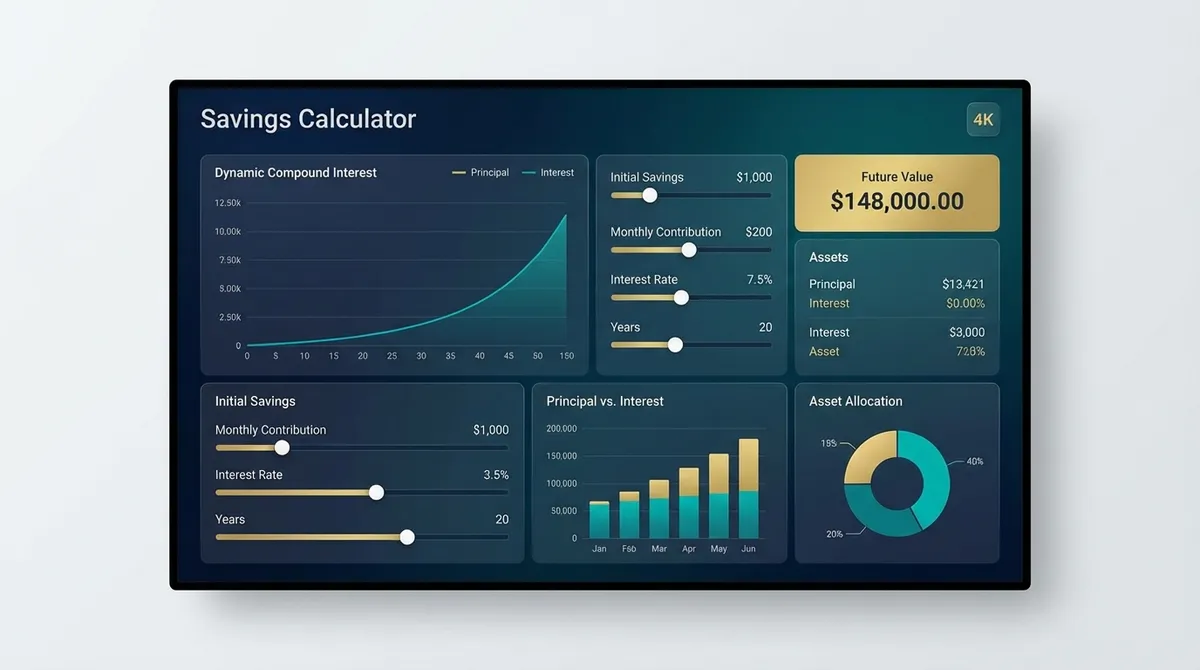
A savings calculator is your financial crystal ball—revealing exactly how your money can grow through the power of compound interest and disciplined saving. Whether you're building an emergency fund, saving for a down payment, or planning for retirement, understanding how to project your savings growth is essential for achieving your financial goals in 2025's dynamic interest rate environment.
What Is a Savings Calculator and Why Does It Matter in 2025?
A savings calculator is a financial tool that projects how your money will grow over time based on your initial deposit, monthly contributions, interest rate (APY), and time horizon. Unlike simple calculations, our advanced savings calculator above factors in compound interest frequency, giving you precise projections that match real-world bank account behavior.
In 2025, with high-yield savings accounts offering 4.5% to 5.25% APY—more than 10 times the national average of 0.45%—understanding these calculations has never been more critical. The difference between parking your money in a traditional big bank (0.01% APY) versus a high-yield account could mean earning over $5,000 more in interest on a $10,000 deposit over 10 years.
- •Top High-Yield Savings Accounts: 5.00% - 5.25% APY (Varo Bank, AdelFi, Fitness Bank)
- •Popular Online Banks: 4.35% - 4.60% APY (Marcus by Goldman Sachs, Ally Bank, Capital One)
- •National Average: 0.45% APY (FDIC data as of October 2025)
- •Traditional Big Banks: 0.01% - 0.03% APY (Chase, Bank of America, Wells Fargo)
How Our Savings Calculator Works: The Compound Interest Formula
Our calculator uses the standard compound interest formula with contributions, which accounts for regular monthly deposits—a feature most basic calculators miss. Here's the exact formula:
Where:
- P = Initial principal balance ($10,000 in our default example)
- r = Annual interest rate (4.5% or 0.045 as a decimal)
- n = Number of times interest compounds per year (12 for monthly)
- t = Number of years (10 years)
- PMT = Monthly contribution ($500)
Real-World Example: Sarah's Emergency Fund Journey
Let's see how this works with a realistic scenario. Sarah, 28, wants to build a robust emergency fund. She starts with $5,000 and can contribute $400 monthly. She chooses a high-yield savings account offering 4.75% APY, compounded monthly.
Without compound interest (simple savings), Sarah would have only $31,050. The extra $197 comes from interest earning interest—a small but meaningful difference that grows substantially over longer periods.
What Factors Affect Your Savings Growth?
Four key factors determine how quickly your savings grow. Understanding each helps you optimize your strategy:
The annual percentage yield is your most powerful lever. A 1% increase in APY can mean thousands of dollars over time. In 2025, the gap between traditional banks (0.01%) and high-yield accounts (5.25%) is wider than ever, making bank selection critical.
Time is compound interest's best friend. The longer your money grows, the more dramatic the compounding effect. Starting early—even with small amounts—beats waiting to save larger sums later.
Consistent contributions supercharge your growth. Even small increases make a massive difference. Automating transfers from checking to savings removes temptation and builds discipline.
How often interest compounds (daily, monthly, quarterly) slightly affects your total. Daily compounding yields the most growth, though the difference is small compared to rate and time.
The Rule of 72: A Quick Mental Math Trick
While our calculator gives you precise numbers, the "Rule of 72" helps you estimate saving growth in your head. It answers the question: "How long will it take to double my money?"
Years to Double = 72 ÷ Interest Rate
*This illustrates why APY matters so much. A small increase in rate drastically cuts the time needed to build wealth.
Common Savings Mistakes to Avoid
Parking emergency funds in big banks earning 0.01% is like stuffing cash under a mattress. Move excess savings to high-yield accounts immediately.
Manual transfers fail when life gets busy. Set up automatic transfers on payday to treat savings like a non-negotiable bill.
With inflation at 3-4%, money in a 0.45% account loses purchasing power. Your high-yield savings account should at least aim to preserve buying power.
Define what constitutes an emergency (medical, job loss, car repairs). A sale at your favorite store doesn't count.
Advanced Strategies for Different Savings Goals
- • Target: $15,000-$30,000 for most households
- • Account: High-yield savings (4.5%+ APY)
- • Strategy: Start with $1,000, then build to 1 month expenses, then 3-6 months
- • Timeline: 12-24 months for full fund
- • Examples: Car down payment, vacation, wedding
- • Account: High-yield savings or short-term CDs
- • Strategy: Calculate exact needed amount and deadline
- • Use calculator above to determine monthly savings required
- • Target: 20% of home price + closing costs
- • Account: High-yield savings or CD ladder
- • Strategy: Increase contributions as income grows
- • Consider: I Bonds for inflation protection (up to $10k/year)
Tax Implications: What You Need to Know
The interest you earn in savings accounts is taxable as ordinary income. Your bank will send you a 1099-INT form for interest over $10. While you can't avoid taxes, you can optimize:
- Tax-Advantaged Accounts: Series I Bonds grow tax-deferred for 30 years and are state/local tax-free
- Emergency Fund Priority: Don't let taxes deter you from maintaining adequate savings
- Record Keeping: Track your contributions vs. interest for accurate tax reporting
Key Takeaways
- 1Act Now: Open a high-yield savings account today. The rate difference is too significant to ignore in 2025.
- 2Automate Everything: Set up automatic transfers on payday. You can't spend what you don't see.
- 3Use Our Calculator: Run scenarios monthly. Adjust contributions as your income grows to accelerate your goals.
- 4Stay Consistent: Time in the market beats timing the market. Even small, regular contributions compound dramatically.
Remember: Our savings calculator above uses real 2025 interest rates and compound interest formulas to give you accurate projections. Experiment with different scenarios, compare the impact of various APYs, and create a savings plan that aligns with your financial goals. The sooner you start, the more powerful compound interest becomes.
Sources & Methodology: Interest rate data sourced from FDIC National Rates, Bankrate, Investopedia, and NerdWallet as of November 2025. Calculations use standard compound interest formulas with monthly contribution timing. All projections are estimates; actual results may vary based on changing rates and bank policies.