Complete Guide: Master Your Financial Targets with Precision
Why This Matters
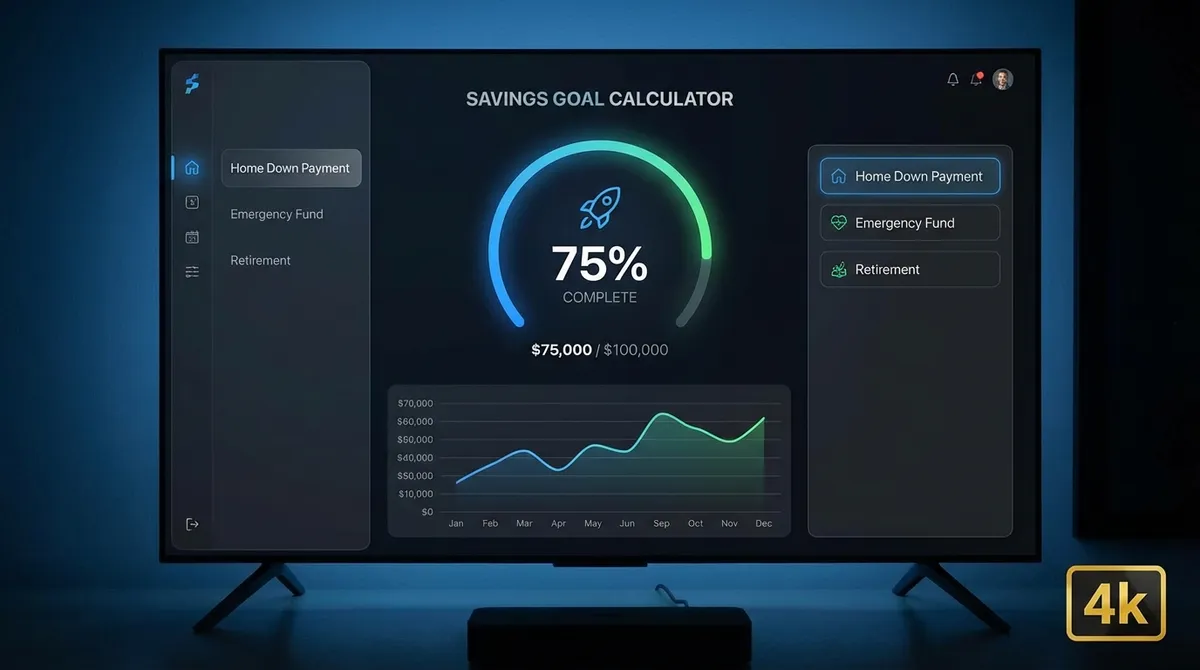
Achieving a major financial milestone—whether it's buying a first home, funding a dream wedding, or building a robust emergency cushion—rarely happens by accident. It requires a strategy. This Savings Goal Calculator bridges the gap between "I hope to save" and "I have a plan." By reverse-engineering your goal, we determine the exact monthly contribution required, factoring in the powerful boost of compound interest to show you exactly how to get there.
1Understanding the Mechanics of Saving
Many people approach savings linearly: "If I save $500 a month for 10 months, I'll have $5,000." While true for a piggy bank, modern finance is non-linear thanks to interest. When you save in a high-yield account or investment vehicle, your money earns money, and then that money earns money.
Linear Saving
You save $100/mo into a shoebox.
Slow & Steady
Compound Saving
You save $100/mo into a 5% HYSA.
Accelerated Growth
The Formula Behind the Tool
Our calculator uses the Future Value of an Annuity Due formula, rearranged to solve for the regular payment (PMT). This assumes you make deposits at the beginning of each period (e.g., when you get your paycheck), which is standard for savings goals.
Where r is the periodic interest rate and n is the total number of periods. This mathematical precision ensures you don't under-save for your target date.
23 Strategies to Reach Your Goal Faster
Increase Frequency
Switching to bi-weekly deposits aligns with most paychecks and results in 26 half-payments per year—effectively 13 full monthly payments—painlessly boosting your annual savings by 8%.
Hunt for Yield
Accepting 0.1% interest is a choice. Moving to a 4.5% High-Yield Savings Account (HYSA) can reduce your required contribution by hundreds of dollars over time without any extra effort.
Automate Windfalls
Commit in advance to saving 50% of any "found money"—bonuses, tax refunds, or birthday cash. This accelerates your timeline dramatically.
3Real-World Planning Scenarios
The $5,000 Vacation (1 Year)
Goal: Save $5,000 in 12 months for a trip to Italy.
Strategy: High-Yield Savings Account (4.5% APY).
Result: You need to save $408/month. The interest pays for a nice dinner (~$112 earned).
The $60,000 Down Payment (5 Years)
Goal: Buy a house in 5 years.
Strategy: Moderate Conservative Portfolio (6.0% Return).
Result: With $5,000 starting cash, you need $791/month. Your money warms up and earns roughly $7,500 in interest.
How to Use This Savings Goal Calculator
This tool is designed to reverse-engineer your financial goals. Instead of guessing how much to save, you can input your target and let the math tell you the roadmap. Here is a step-by-step guide to getting the most accurate results:
1. Define Your Savings Goal
Enter the total amount you need. Be specific. If you are saving for a house, don't just put the down payment; include closing costs (usually 2-5% of the purchase price) and a moving fund. Precision in your goal prevents shortfalls later.
2. Determine Your Time Horizon
Input the number of months or years until you need the money. A shorter horizon requires significantly higher monthly contributions because compound interest has less time to work its magic. Conversely, extending your timeline by just one year can surprisingly lower your monthly burden.
3. Check Current Interest Rates
The "Annual Interest Rate" field has a massive impact on long-term goals. For short-term goals (under 2 years), use High-Yield Savings Account (HYSA) rates. For medium-term goals (3-7 years), you might look at blended rates from bonds or conservatory portfolios. For long-term goals (10+ years), stock market historical averages (adjusted for inflation) might be appropriate.
4. Input Starting Balance
If you have already started saving, enter that amount. This "seed money" is powerful because it starts compounding immediately on day one, reducing the amount of new capital you need to contribute.
Advanced Savings Strategies
The Power of "found Money"
One of the fastest ways to accelerate your savings goal without changing your daily standard of living is to commit to the "50% Rule for Windfalls." Whenever you receive unexpected money—a tax refund, a work bonus, a cash gift, or even finding $20 in an old coat—immediately transfer 50% of it to your savings goal. This simple habit can cut months or even years off your timeline.
Automate to Dominate
Willpower is a finite resource; automation is infinite. Set up an automatic transfer from your checking account to your savings account to occur 24 hours after your paycheck hits. By "paying your goal first," you remove the temptation to spend that money. You learn to live on what remains, rather than saving what remains (which is often nothing).
Visual Anchoring
Psychological studies show that people save more when they visualize the end result. Rename your savings account in your banking app to the specific goal, e.g., "Tahiti 2026" or "Dream Home Fund." Seeing the name every time you log in reinforces the purpose of the sacrifice and reduces the likelihood of raiding the fund for impulse purchases.
Laddering Strategy
For goals with flexible timelines, consider "CD Laddering." As you accumulate cash, lock portions of it into Certificates of Deposit (CDs) with staggering maturity dates. This often yields higher interest rates than standard savings accounts while maintaining some liquidity as CDs mature at regular intervals.
The Psychology of Wealth: Why We Fail to Save
Financial math is simple; human behavior is hard. Behavioral economists have identified several cognitive biases that sabotage our savings goals. Understanding them is the first step to overcoming them.
Hyperbolic Discounting
We value immediate rewards (buying a coffee now) much higher than future rewards (having $500 in 10 years). Our brains are wired to prioritize the present.
Fix: Make saving automatic so you don't have to make a choice every month.
Parkinson's Law
"Work expands to fill the time available." Similarly, "Spending expands to match income availability." If you get a raise, you usually just spend more.
Fix: Save your raises. If you get a 5% raise, increase your auto-transfer by 5% immediately.
The "What the Hell" Effect
When we slip up on a goal (create a budget violation), we tend to abandon the entire goal. "I already spent $100 too much, so I might as well spend another $200."
Fix: Track progress weekly, not monthly. A bad week doesn't have to become a bad month.
Optimism Bias
We tend to underestimate future costs and overestimate future income. "I'll save more next month when things are calmer."
Fix: Treat your savings contribution like a bill. You wouldn't skip your rent because you're "busy."
Frequently Asked Questions (FAQ)
How much interest will I earn on my savings?
The interest earned depends on the APY (Annual Percentage Yield) of your account. Traditional brick-and-mortar banks often offer 0.01% to 0.10%, while online High-Yield Savings Accounts (HYSAs) can offer 4.00% to 5.00% or more. Over 5 years on a $10,000 balance, the difference is hundreds of dollars. Always shop for the best rate for your specific timeline.
Should I invest my savings or keep it in cash?
This depends on your timeline. For goals less than 3-5 years away (like a wedding or down payment), the stock market is generally considered too volatile; cash equivalents like HYSAs, CDs, or Money Market Funds are safer. For long-term goals (10+ years), inflation is your biggest enemy, and investing in a diversified portfolio is typically necessary to preserve purchasing power.
What if I miss a monthly contribution?
Life happens. If you miss a payment, you have two options: slightly increase your future monthly payments to catch up, or accept that your goal date will be pushed back. Our calculator allows you to adjust variables dynamically to see how a missed payment impacts your timeline.
Does this calculator account for inflation?
This version calculates the nominal value. To account for inflation, you should increase your "Savings Goal" amount by the expected inflation rate. For example, if you need $10,000 in 5 years and expect 3% inflation, aim for roughly $11,600 to maintain the same purchasing power.
Is it better to save a fixed amount or a percentage of income?
For a specific fixed goal (like buying a $20,000 car), saving a fixed dollar amount is necessary to ensure you hit the target. For general wealth building or retirement, saving a percentage (e.g., 20%) is better because your savings rate automatically scales up as your income grows, preventing lifestyle creep.
Disclaimer: This tool is for educational purposes. Investment returns are projections and never guaranteed.