What Is a SEP IRA and Why It Matters in 2025?
A SEP IRA (Simplified Employee Pension Individual Retirement Account) is a powerful retirement savings vehicle designed specifically for self-employed individuals and small business owners. It allows employers—including self-employed entrepreneurs—to make tax-deductible contributions to traditional IRAs established for themselves and their eligible employees. In 2025, with contribution limits up to $70,000 annually, the SEP IRA offers one of the highest contribution limits of any retirement plan, making it an exceptional tool for building substantial retirement wealth while reducing current tax liability.
Unlike traditional 401(k) plans or SIMPLE IRAs, SEP IRAs are remarkably easy to set up and maintain. There's minimal paperwork, no annual filing requirement with the IRS, and you have complete flexibility in how much you contribute each year—even allowing you to skip contributions entirely during lean years. This makes the SEP IRA particularly attractive for freelancers, independent contractors, and small business owners with variable income streams.
Key Statistic: A 40-year-old self-employed consultant earning $150,000 annually can contribute approximately $28,000 to a SEP IRA in 2025—that's more than 4x the $7,000 limit of a traditional IRA. Over 25 years with 8% average returns, this aggressive saving strategy could grow to over $2.1 million, demonstrating why the SEP IRA is often called the "secret weapon" of retirement planning for entrepreneurs.
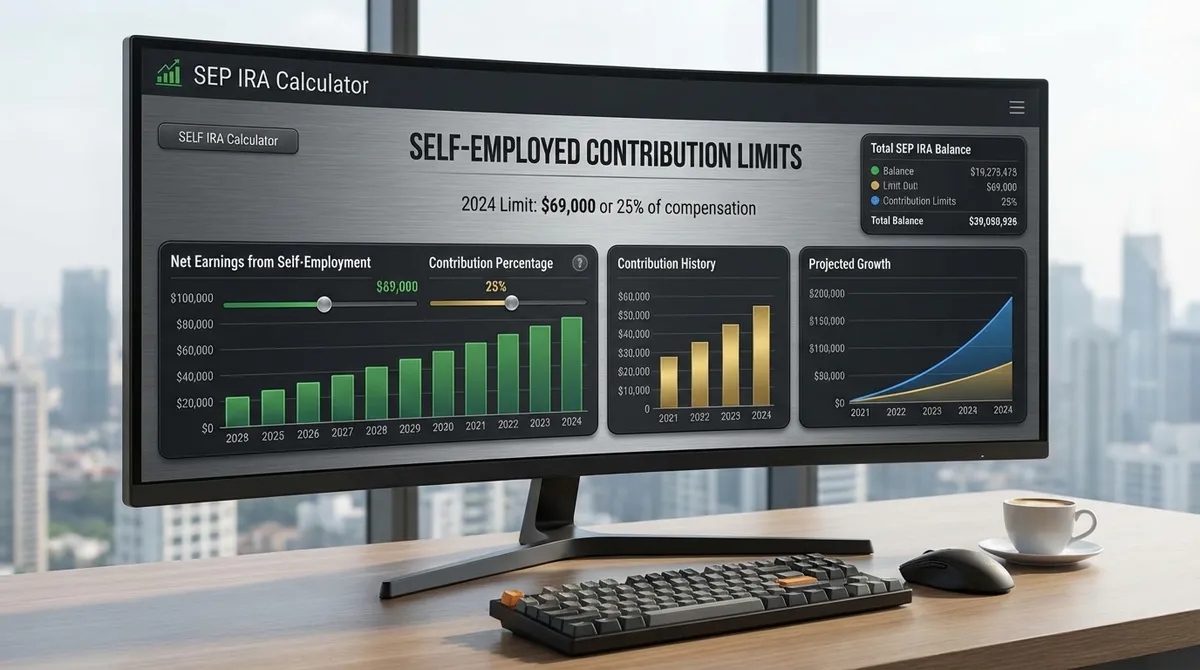
How SEP IRA Calculations Work: Understanding Employer Contribution Limits
The SEP IRA calculation fundamentally differs from other retirement plans because contributions are made solely by the employer, not through employee salary deferrals. This means you can only contribute up to 25% of an employee's compensation, including your own compensation if you're self-employed. However, there's a critical distinction for self-employed individuals that most people misunderstand.
The Two Main Calculation Scenarios
Scenario 1: Employee Receiving SEP IRA Contribution
If you work for a company that offers a SEP IRA:
• 25% of employee's compensation, OR
• $70,000 (2025 limit)
Example: If you earn $80,000 annually, your employer can contribute up to $20,000 (25% × $80,000), which is below the $70,000 cap.
Scenario 2: Self-Employed Individual
This is where it gets interesting. For self-employed individuals, the calculation is more complex:
Why? Because the contribution reduces your net earnings,
which in turn reduces the contribution base.
For a self-employed person with $100,000 net earnings:
• Self-employment tax: ~$14,130
• Deductible half: $7,065
• Contribution base: $92,935
• Maximum contribution: ~$20,000 (20% effective rate)
Real-World Example: Maria's SEP IRA Journey to $1.8 Million
Meet Maria, a 35-year-old freelance marketing consultant with a thriving business. She earns $150,000 in net self-employment income and is looking to maximize her retirement savings while minimizing her current tax burden. Unlike her W-2 friends limited to $7,000 IRA contributions, Maria discovers the SEP IRA's powerful advantage.
Starting Position (Age 35)
Results at Age 65
The remarkable aspect of Maria's journey isn't just the $1.86 million final balance—it's the accelerated growth that occurs later in her career. During the first decade, her account grows to $410,000 (primarily from her contributions). In the next 10 years, it reaches $950,000 as compound interest begins to dominate. In the final decade, her account explodes to $1.86 million, with the last 5 years alone generating more growth than the entire first 15 years combined. This demonstrates why starting early with maximum contributions matters more than trying to catch up later.
⚡ Key Insight: Maria's $27,380 annual contribution saves her approximately $8,200 in current-year taxes (assuming a 30% combined tax rate). Over 30 years, that $8,200 annual tax savings, if invested, adds another $1.02 million to her retirement wealth—essentially doubling the power of her SEP IRA strategy.
💡 Expert Tips from Jurica Šinko to Maximize Your SEP IRA
1. Contribute Early and Consistently
Unlike traditional IRAs with fixed deadlines, SEP IRA contributions can be made until your tax filing deadline (including extensions). This gives you maximum flexibility, but don't procrastinate. Contributing in January instead of April gives your money an extra 15 months of tax-deferred growth.
2. Understand the 20% vs 25% Distinction
If you're self-employed, don't mistakenly think you can contribute 25% of gross income. The effective rate is 20% due to the circular calculation. Use our calculator or IRS Publication 560 to determine your exact contribution limit and avoid over-contribution penalties.
3. Leverage Income Fluctuations
SEP IRAs allow you to contribute 0% in lean years and up to 25% (20% effective for self-employed) in profitable years. This flexibility is perfect for businesses with variable income. In exceptionally good years, max out your contribution to reduce taxable income and build retirement wealth faster.
4. Combine With a Roth IRA
SEP IRA contributions don't affect your ability to contribute to a Roth IRA. Consider maxing out both: use the SEP IRA for current tax deductions and the Roth IRA for tax-free retirement withdrawals. This diversification strategy provides tax flexibility in retirement.
5. Set Up Automatic Contributions
While SEP IRA contributions are typically made annually, set up automatic monthly transfers to a high-yield savings account. When tax time arrives, you'll have the funds ready to maximize your contribution without scrambling or missing the opportunity.
⚠️ Common SEP IRA Mistakes That Destroy Retirement Wealth
Mistake 1: Contributing Too Much (20% vs 25% Confusion)
This is the #1 error for self-employed individuals. You calculate 25% of gross income and contribute that amount, but the IRS limits you to an effective 20% rate. A self-employed person earning $100,000 who contributes $25,000 has over-contributed by $5,000, facing potential 10% excise taxes and correction headaches. Always use the circular calculation or our calculator to determine your exact limit.
Mistake 2: Missing the Contribution Deadline
SEP IRA contributions must be made by your tax filing deadline (including extensions). Many self-employed individuals file extensions until October 15th but forget to make the contribution by April 15th, thinking they have until October. This mistake costs thousands in potential tax deductions and years of compound growth. Mark April 15th as "SEP IRA Contribution Day" on your calendar.
Mistake 3: Forgetting Employee Eligibility Rules
If you have employees, you must contribute the same percentage for all eligible employees as you contribute for yourself. Eligible employees are those who: are at least 21 years old, have worked for you in 3 of the last 5 years, and earned at least $750 in the contribution year. Many business owners miscalculate eligibility or forget terminated employees, leading to compliance failures and penalties.
Mistake 4: Not Establishing the SEP IRA Before Year-End
While you have until your tax filing deadline to contribute, the SEP IRA plan itself must be established by December 31st of the tax year for which you want to contribute. Setting up the plan in January to contribute for the previous year is too late. Establish your plan by December 31st, even if you plan to contribute later.
Mistake 5: Under-Contributing in High-Income Years
The flexibility to contribute 0% to 25% (or 20% for self-employed) means many people contribute conservatively even in their best income years. This is tax-inefficient. In a year where you earn $150,000, maxing out your SEP IRA contribution saves approximately $12,000 in taxes (assuming a 32% marginal rate). That's an immediate 32% return on your contribution that most investments can't match.
SEP IRA vs Other Retirement Plans: Making the Right Choice
While the SEP IRA is powerful, it's not always the best choice for every business. Understanding how it compares to other retirement plans helps you make an informed decision based on your specific situation, number of employees, and income level.
SEP IRA
- ✓ Up to $70,000 contribution limit
- ✓ Very easy to set up and maintain
- ✓ Flexible annual contributions
- ✗ Only employer contributions
- ● Best for: Self-employed, no employees or few employees
Solo 401(k)
- ✓ Up to $70,000 + $7,500 catch-up (50+)
- ✓ Employee and employer contributions
- ✓ Potential for Roth component
- ✗ More complex administration
- ● Best for: Self-employed with no employees
SIMPLE IRA
- ● Up to $16,000 + $3,500 catch-up (50+)
- ✓ Lower contribution limits
- ✓ Simpler than 401(k)
- ✗ Mandatory employer contributions
- ● Best for: Small businesses with employees (up to 100)
📊 Decision Framework
Choose SEP IRA if:
- • You're self-employed with no employees
- • You want maximum contribution flexibility
- • You have variable income year to year
- • You want the simplest possible administration
- • You can contribute 20-25% of income annually
Consider other options if:
- • You want to contribute more than 20% of income
- • You want a Roth component (Roth Solo 401(k))
- • You have employees and want lower costs
- • You want loan provisions (401(k) feature)
- • You want to maximize contributions above $70,000
Step-by-Step: Setting Up Your SEP IRA in 15 Minutes
Establishing a SEP IRA is remarkably simple compared to other retirement plans. You can complete the process in under 15 minutes with any major financial institution. Here's exactly how to do it:
Choose a Financial Institution
Major providers include Vanguard, Fidelity, Schwab, and E*TRADE. Compare fees, investment options, and customer service. Most offer $0 setup fees and $0 maintenance fees.
Complete IRS Form 5305-SEP
This is your written agreement. Most providers have pre-filled versions. You'll specify eligibility requirements (age 21, 3-of-5 years, $750 minimum compensation).
Open SEP-IRA Accounts
Open a SEP-IRA for yourself and each eligible employee. Each person owns and controls their own account, including investment decisions.
Notify Eligible Employees
Provide each eligible employee with a copy of Form 5305-SEP, its instructions, and a statement that you will contribute to their SEP-IRA.
Make Contributions by Tax Deadline
Contribute to all eligible SEP-IRAs by your business tax filing deadline, including extensions. That's typically April 15th, or October 15th if you file an extension.
✅ Setup Complete!
Once you've completed these 5 steps, you're all set. There are no annual IRS filings required for SEP IRAs, making them truly "set it and forget it" for busy entrepreneurs. Just remember to contribute by your tax deadline each year.
Advanced SEP IRA Strategies
Year-End Income Timing
If you're close to the $350,000 compensation limit, consider accelerating or deferring income to maximize your contribution potential. A $10,000 shift in timing could mean an extra $2,000 in annual contributions. Use our estimated tax calculator to plan ahead.
Multiple Retirement Accounts
SEP IRA doesn't affect your ability to contribute to a Traditional IRA or Roth IRA. Combine them: max out your employer SEP IRA contribution, then add $7,000 (+$1,000 catch-up if 50+) to a Roth IRA for tax diversification.
Side Hustle + W-2 Job
You can contribute to a SEP IRA for your self-employment income even if you participate in your employer's Social Security or 401(k) at your W-2 job. This allows you to save doubly.
Spousal Contribution Strategy
If your spouse works in the business, both of you can receive SEP IRA contributions. A business earning $200,000 could contribute $50,000 to each spouse. See how this affects your tax deductions. For official limits, check the IRS SEP Contribution Limits.
Key Takeaways: Your Path to SEP IRA Success
The SEP IRA is arguably the most powerful retirement tool for self-employed individuals and small business owners. With contribution limits up to $70,000 annually, tax-deductible contributions, and minimal administrative burden, it's hard to beat for building substantial retirement wealth while optimizing current tax liability.
The key is understanding the calculation nuances—especially the 20% effective rate for self-employed individuals—and committing to consistent, maximum contributions during your high-income years. The flexibility to reduce or skip contributions during lean years provides a safety net that traditional 401(k) plans can't match.
Your Action Plan:
- Use our calculator to determine your maximum contribution
- Open a SEP IRA by December 31st if you haven't already
- Set up automatic transfers to accumulate contribution funds
- Contribute the maximum amount by your tax deadline
- Consider adding a Roth IRA for tax diversification
- Review and adjust your strategy annually with income changes
Remember: The SEP IRA isn't just a retirement account—it's a strategic business tool that rewards entrepreneurship with substantial tax savings and accelerated wealth building. Use it wisely, contribute consistently, and let compound interest work its magic over the decades ahead.