What Is a SIMPLE IRA and How Does It Work in 2025?
A SIMPLE IRA (Savings Incentive Match Plan for Employees) is a retirement savings plan designed specifically for small businesses with 100 or fewer employees. Think of it as the middle ground between a traditional IRA and a 401(k) plan—offering higher contribution limits than a regular IRA while maintaining the simplicity and lower administrative costs that small business owners need.
In 2025, SIMPLE IRAs allow employees to contribute up to $16,500 annually through salary deferrals, with an additional $3,500 catch-up contribution for those age 50 and older. What makes SIMPLE IRAs particularly attractive is the mandatory employer contribution—either a dollar-for-dollar match up to 3% of compensation or a 2% nonelective contribution for all eligible employees, regardless of whether they contribute themselves.
Key Statistic: According to IRS data, over 2 million small businesses use SIMPLE IRAs to help their employees save for retirement. The average participant contributes approximately $8,200 annually, with employer matches adding another $2,500 on average—demonstrating how these plans effectively boost retirement savings for workers at small companies.
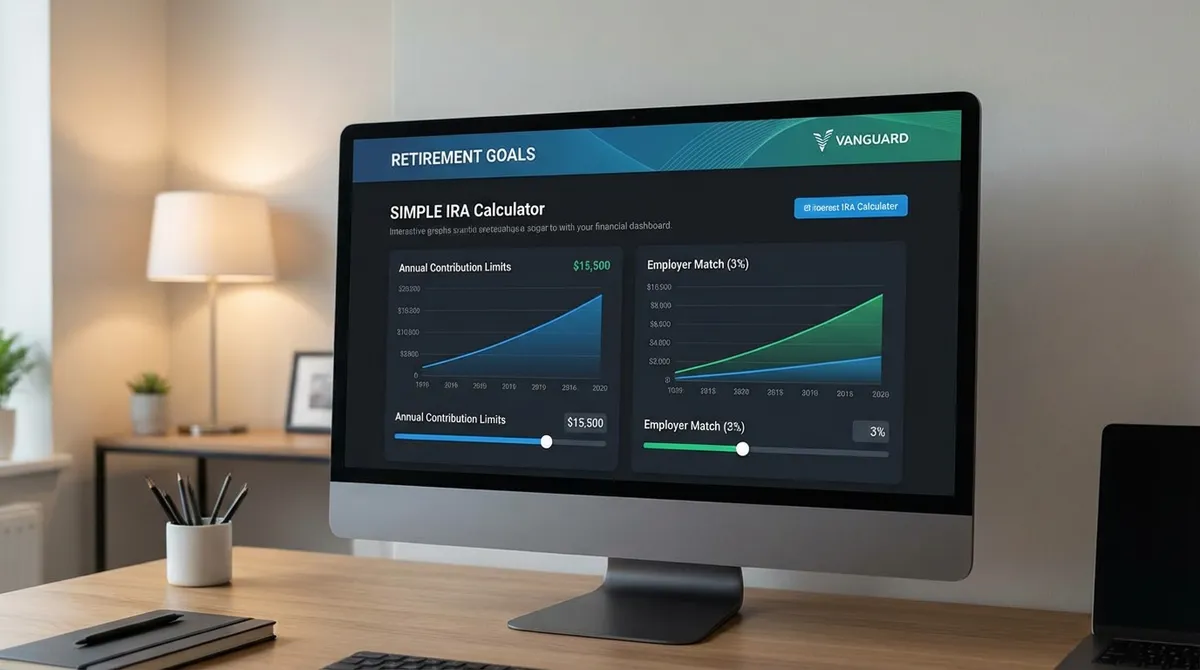
Understanding SIMPLE IRA Contribution Rules: Employee and Employer Responsibilities
One of the most important aspects of SIMPLE IRAs is the dual contribution structure—both employees and employers must contribute. This mandatory employer contribution distinguishes SIMPLE IRAs from other retirement plans and provides a guaranteed boost to employee savings.
Employee Contributions
- •2025 Limit: Up to $16,500 annually
- •Catch-up (50+): Additional $3,500
- •Percentage: Usually 1-15% of salary
- •Flexibility: Can change percentage during enrollment
Employer Contributions
- •Option 1: 3% dollar-for-dollar match
- •Option 2: 2% nonelective for all eligible
- •Mandatory: Must contribute every year
- •Tax Deductible: Employer contributions are tax-deductible
How the 3% Match Formula Works
With the 3% matching contribution, employers match employee contributions on a dollar-for-dollar basis. For example, if you earn $50,000 annually and contribute 10% ($5,000), your employer would match up to 3% of your salary ($1,500). However, if you only contributed 2% ($1,000), your employer would only match $1,000—leaving $500 of potential employer contribution on the table.
Understanding the 2% Nonelective Option
The 2% nonelective contribution works differently. The employer contributes 2% of each eligible employee's compensation regardless of whether the employee contributes anything themselves. For a $50,000 salary, this means a guaranteed $1,000 employer contribution, even if the employee chooses not to participate. This option provides employees with some employer contribution regardless of their participation level.
Real-World SIMPLE IRA Examples: Three Common Scenarios
Understanding how SIMPLE IRA contributions work in practice helps you make informed decisions about your retirement savings. Let's explore three realistic scenarios to see how the numbers play out.
Scenario 1: The Young Professional (Age 28, $45,000 salary)
• Annual Salary: $45,000
• Employee Contribution: 8% ($3,600)
• Employer Match: 3% ($1,350)
• Total Annual: $4,950
• Percentage of Salary: 11%
• Total Contributions: $148,500
• Estimated Growth (7% avg): $389,247
• Final Balance: $537,747
• Monthly Retirement Income: ~$2,150
Scenario 2: Mid-Career Saver (Age 45, $75,000 salary)
• Annual Salary: $75,000
• Employee Contribution: 12% ($9,000)
• Employer Match: 3% ($2,250)
• Total Annual: $11,250
• Percentage of Salary: 15%
• Total Contributions: $225,000
• Estimated Growth (7% avg): $294,368
• Final Balance: $519,368
• Monthly Retirement Income: ~$2,075
Scenario 3: Catch-Up Contributor (Age 52, $85,000 salary)
• Annual Salary: $85,000
• Employee Contribution: $16,500 (max)
• Catch-Up Contribution: $3,500
• Employer Match: 3% ($2,550)
• Total Annual: $22,550
• Percentage of Salary: 26.5%
• Total Contributions: $338,250
• Estimated Growth (7% avg): $303,419
• Final Balance: $641,669
• Monthly Retirement Income: ~$2,565
Common SIMPLE IRA Mistakes and How to Avoid Them
Even with straightforward retirement plans like SIMPLE IRAs, participants and employers can make costly mistakes. Being aware of these common pitfalls can help you maximize your benefits and avoid penalties.
Mistake 1: Not Contributing Enough to Maximize the Employer Match
Many employees don't realize they're leaving free money on the table. With the 3% matching option, you need to contribute at least 3% of your salary to receive the full employer match.
Solution: Calculate 3% of your salary and ensure you contribute at least that amount. On a $60,000 salary, contributing only 2% means losing $600 in employer matching funds annually.
Mistake 2: Exceeding Contribution Limits
Contributing more than the IRS limit can trigger excess contribution penalties and require corrective distributions.
Solution: Use our calculator to verify your contribution amounts. The 2025 limit is $16,500 for those under 50, plus an additional $3,500 catch-up for those 50 and older.
Mistake 3: Not Starting Early Enough
Time is your greatest asset with retirement savings. Starting five years later can cost you hundreds of thousands in compound growth.
Solution: Start contributing as soon as you're eligible, even if it's just 1-2% initially. You can always increase your percentage as your income grows.
Tax Advantages and Benefits of SIMPLE IRAs
SIMPLE IRAs offer significant tax advantages that make them powerful tools for retirement savings. Understanding these benefits helps you appreciate why these plans are so valuable for both employees and employers.
Employee Tax Benefits
- ✓Tax-Deferred Growth: Contributions grow without annual taxation
- ✓Current Tax Deduction: Reduces current year's taxable income
- ✓Potential Tax Bracket Changes: May withdraw at lower rate in retirement
Employer Tax Benefits
- ✓Tax-Deductible Contributions: All employer contributions reduce taxable income
- ✓No FICA Taxes: Employer matching contributions aren't subject to payroll taxes
- ✓Business Expense Deduction: Plan administration costs are deductible
How to Use Our SIMPLE IRA Calculator Effectively
Our SIMPLE IRA calculator helps you understand your contribution limits, employer matching, and total annual savings. Follow these steps to get the most accurate and useful results for your financial planning.
Enter Your Annual Salary
Input your total annual compensation. This forms the base for calculating both your percentage-based contributions and employer matching amounts.
Set Your Contribution Percentage
Choose what percentage of your salary to contribute. Remember, contributing at least 3% ensures you receive the maximum employer match.
Specify Your Age
Your age determines catch-up contribution eligibility. If you're 50 or older, you'll see the additional $3,500 catch-up amount automatically calculated.
Select Employer Contribution Type
Choose between the 3% dollar-for-dollar match or 2% nonelective contribution. Check with your employer to confirm which option they use.
Frequently Asked Questions About SIMPLE IRAs
Can I contribute to both a SIMPLE IRA and a traditional IRA?
Yes, you can contribute to both a SIMPLE IRA and a traditional IRA or Roth IRA in the same year. However, your contributions to the traditional/Roth IRA do not affect your SIMPLE IRA contribution limit. The SIMPLE IRA limit ($16,500 for 2025) is separate. Compare plans with our SEP IRA calculator or investment calculator. Also consider tax deductions.
What happens if I withdraw money early from my SIMPLE IRA?
Withdrawals before age 59½ are generally subject to a 10% early withdrawal penalty plus regular income tax. However, for SIMPLE IRAs, there is a special "2-year rule." If you withdraw funds within the first two years of participating in the plan, the penalty increases to 25%. After the two-year period, the standard 10% penalty applies.
Can I roll over my SIMPLE IRA to another retirement account?
Yes, but you must wait until the two-year participation period has passed. After two years, you can roll over your SIMPLE IRA funds tax-free to a traditional IRA, 401(k), 403(b), or governmental 457(b) plan. If you try to roll it over within the first two years, it will be treated as a distribution and may be subject to taxes and the 25% penalty.
Does my employer have to match my catch-up contributions?
It depends on the formula. If your employer uses the 2% nonelective contribution, they calculate it based on your compensation, not your contribution amount, so catch-ups don't affect it. If they use the 3% match, they match your contribution dollar-for-dollar up to 3% of your compensation. Catch-up contributions are eligible for the match, but the total match cannot exceed the 3% cap.
Are SIMPLE IRA contributions tax-deductible?
For employees, salary deferral contributions are made pre-tax, which reduces your taxable income for the year. You don't take a separate deduction on your tax return. For employers, all matching or nonelective contributions made to employees' accounts are fully tax-deductible as a business expense.
Making the Most of Your SIMPLE IRA: Final Recommendations
SIMPLE IRAs offer small business employees a powerful tool for retirement savings with mandatory employer contributions that provide a significant advantage over traditional IRAs. By understanding the contribution limits, employer matching rules, and tax benefits, you can maximize this valuable retirement benefit.
The key to success with a SIMPLE IRA is consistency and maximizing employer contributions. Always contribute enough to receive the full employer match—this is essentially free money that immediately doubles your return. For those under 50, aim to contribute the maximum $16,500 if possible. If you're 50 or older, take advantage of the additional $3,500 catch-up contribution to accelerate your retirement savings.
Action Steps: Use our calculator regularly to track your contributions, review your employer's matching policy annually, and increase your contribution percentage with each salary raise. Remember, even small increases compounded over decades can result in substantial retirement wealth. The combination of employee contributions, employer matching, and tax-deferred growth makes SIMPLE IRAs one of the most effective retirement savings tools available to small business employees.