What Is the Standard Deduction and Why Does It Matter in 2025?
The standard deduction is essentially the IRS's "no-questions-asked" tax break. It’s a specific dollar amount that automatically reduces your taxable income, no matter your actual expenses. Think of it as a baseline discount on your taxes. If you earned $60,000 and the standard deduction is $15,750, the IRS only taxes you on $44,250 (which determines your tax bracket liability).
For the 2025 tax year, the IRS has increased these limits again to keep up with inflation. This means you can earn more money tax-free than before. However, the real question isn't just "what is it," but "should I take it?" For about 90% of taxpayers, the answer is yes—but for the other 10%, blindly taking the standard deduction means leaving thousands of dollars on the table (or missing out on credits like the Earned Income Credit).
The "Better Off" Test: The core strategy of tax deductions is simple: you want to reduce your taxable income by the largest amount possible. You should only itemize if your specific deductible expenses (mortgage interest, charity, state taxes, etc.) add up to more than your standard deduction amount.
2025 Standard Deduction Amounts (Official Limits)
Your specific deduction depends on your filing status. Choosing the right status is critical—filing "Head of Household" instead of "Single," if you qualify, grants you a significantly larger deduction.
Single Filers
$15,750
Also applies to Married Filing Separately.
Married Jointly
$31,500
Combined for both spouses.
Head of Household
$23,625
Single with dependents.
Don't Forget the "Plus-Up" Amounts!
If you are 65 or older OR legally blind, you get an additional deduction on top of the base amount. If you are both, you get double the addition.
- Unmarried: +$1,950 per condition
- Married: +$1,550 per condition
Standard vs. Itemized: The Million Dollar Decision
This is where most people get tripped up. The Tax Cuts and Jobs Act of 2017 nearly doubled the standard deduction, making itemizing less common. However, for homeowners in high-tax states or generous donors, itemizing can still save you thousands.
You should consider itemizing if the sum of these expenses is greater than your standard deduction:
Mortgage Interest
Interest paid on the first $750,000 of mortgage debt ($1 million if bought before Dec 16, 2017).
State & Local Taxes (SALT)
State income tax (or sales tax) plus property taxes. Note: This is currently capped at $10,000 per year ($5,000 if married filing separately).
Charitable Donations
Cash or goods donated to qualified non-profit organizations.
Medical Expenses
Unreimbursed medical costs, but ONLY the amount that exceeds 7.5% of your Adjusted Gross Income (AGI).
Real World Example: The "New Homeowner" Trap
Let's look at Mark and Sarah, a married couple filing jointly in 2025. They just bought a house and assume they should itemize.
Their Expenses
- Mortgage Interest: $14,000
- Property Taxes: $6,000
- State Income Tax: $5,000
- Charity: $2,000
- Total Expenses: $27,000
The Decision
Verdict: Even with a house, Mark and Sarah are better off taking the Standard Deduction. They save taxes on an extra $5,500 by NOT itemizing.
Common Pitfalls to Avoid
The "Married Filing Separately" Trap
If your spouse itemizes, YOU MUST ITEMIZE TOO. You cannot have one spouse take the standard deduction while the other itemizes. This often forces the second spouse to itemize with $0 deductions.
Forgetting State Differences
Some states (like California) have their own standard deduction rules. You might take the standard deduction on your federal return but still benefit from itemizing on your state return, if allowed.
The Evolution of the Standard Deduction
To truly understand the value of today's standard deduction, it helps to look at its history. The concept was introduced to simplify tax filing, sparing millions of Americans from the burden of tracking every single receipt.
Pre-2018 (The Old Era)
Before the Tax Cuts and Jobs Act (TCJA), the standard deduction was relatively low—around $6,350 for singles and $12,700 for married couples in 2017. However, taxpayers also got a "Personal Exemption" of $4,050 for themselves and each dependent.
*A family of four had a total reduction of $28,900 ($12,700 + 4 x $4,050).
2018-2025 (The TCJA Era)
The TCJA nearly doubled the standard deduction to simplify filing. The Personal Exemption was eliminated. This shifted millions of filers away from itemizing.
*While simpler, large families arguably lost some tax benefits due to the loss of per-person exemptions, partially offset by an expanded Child Tax Credit.
Inflation Adjustments
Each year, the IRS adjusts the standard deduction for inflation. This "indexing" prevents "bracket creep," ensuring that if your raise only kept up with inflation, you aren't pushed into a higher tax situation. In high-inflation years (like 2022-2023), these jumps were significant (e.g., ~$900 increases).
Why This Matters for Your Long-Term Planning
Knowing that the current high standard deduction is set to expire after 2025 creates a planning window.
- Charitable Bunching: Since itemizing is harder now, consider a "Donor Advised Fund." You can donate 5 years' worth of cash in a single year to exceed the high standard deduction threshold, itemize that year, and then take the standard deduction for the next 4 years while distributing the money from the fund.
- Mortgage Timing: If you are buying a home, the interest deduction is less valuable today than it was in 2017. This effectively increases the "real" cost of borrowing for many middle-class families who no longer see a tax benefit from their mortgage interest.
How to Claim the Standard Deduction (Step-by-Step)
Claiming the standard deduction is one of the easiest parts of filing your taxes. You do not need to fill out complex schedules or provide receipts.
Locate Form 1040
On the standard IRS Form 1040 (U.S. Individual Income Tax Return), look for Line 12 (as of the 2024–2025 tax forms).
Enter Your Deduction Amount
Enter the specific dollar amount for your filing status (e.g., $15,750 for Single). Most tax software calculates and enters this number automatically.
Skip Schedule A
If you take the standard deduction, you do not file Schedule A (Itemized Deductions). This saves significant time and reduces the risk of audit errors related to unsubstantiated expenses.
Frequently Asked Questions
Can I take the standard deduction and still deduct charitable donations?
Generally, no. For the 2025 tax year, you must itemize to claim charitable deductions. There was a temporary "above-the-line" deduction for cash donations during the pandemic years (2020-2021), but that has expired.
If I am dependent on someone else's return, do I get a standard deduction?
Yes, but it is limited. For 2025, the standard deduction for dependents is limited to the greater of $1,350 OR your earned income plus $450 (up to the regular standard deduction amount).
Does the standard deduction include self-employment tax?
No. The standard deduction only reduces your income tax. It does not reduce your self-employment tax (Social Security and Medicare taxes for business owners). However, you can deduct 50% of your self-employment tax "above the line" before you even get to the standard deduction choice.
Can non-resident aliens take the standard deduction?
Typically, no. Non-resident aliens (Form 1040-NR) generally must itemize. However, there are exceptions for students and business apprentices from India due to a specific tax treaty.
The "Tax Cliff" of 2026: What You Need to Know
The current high standard deduction amounts were established by the Tax Cuts and Jobs Act (TCJA) of 2017. These provisions are scheduled to sunset (expire) after December 31, 2025.
Unless Congress acts to extend them:
- The standard deduction would serve roughly cut in half (returning to pre-2018 levels, adjusted for inflation).
- The Personal Exemption (which was eliminated by TCJA) would return.
- Many more people would be forced to return to itemizing to get a decent tax break.
Planning Tip: If you are planning major charitable gifts or medical procedures, keep an eye on tax legislation in late 2025. It might make sense to "bunch" deductions into 2026 if itemizing becomes the norm again.
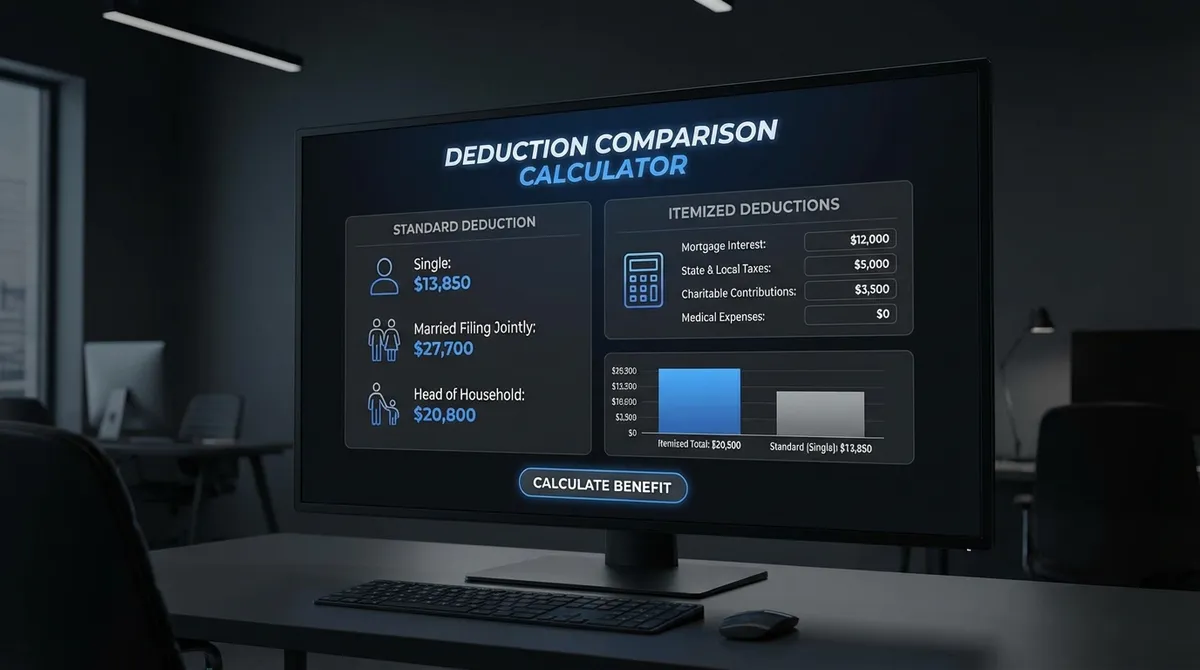
Standard Deduction Calculator 2025 Interface
Marko Šinko
Last updated: January 15, 2025