Time Value Of Money Calculator (TVM) — Free & Accurate Guide
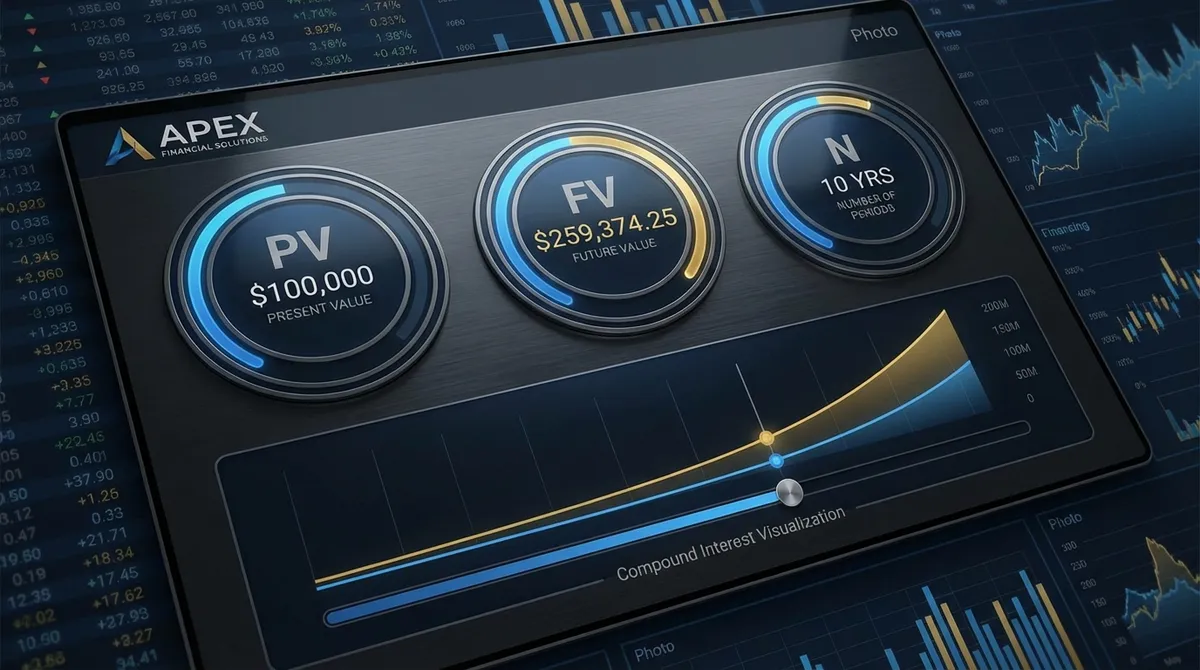
The Time Value of Money (TVM) is the single most fundamental concept in finance. It explains a simple truth: a dollar in your pocket today is worth more than a dollar promised to you next year. Why? Because money available today has the potential to earn interest. Learn more at Investopedia's TVM Guide.
This principle is the bedrock of every financial decision, from mortgage amortization and retirement planning to corporate capital budgeting and lottery payout choices. Whether you are an investor looking to value a stock or a homebuyer calculating payments, TVM math is the engine running under the hood.
Our advanced calculator allows you to solve for any of the five key variables—Present Value, Future Value, Payment, Interest Rate, or Number of Periods—giving you the power to model complex financial scenarios with professional-grade accuracy.
Key Concepts
- Opportunity Cost: Money is worth more now because you can invest it.
- Inflation Risk: Future money has less purchasing power. Calculate the impact with our Inflation Calculator.
- Compounding: Frequency (monthly vs annual) accelerates growth.
- Interconnectedness: Changing one variable impacts all others.
The 5 Variables of TVM
Every financial problem involving time and money can be broken down into five variables. Professional financial calculators (like the HP 12C or TI BA II Plus) use these exact inputs.
Present Value (PV)
Based on the Latin praesentem, this is the current worth of a future sum of money. In a loan, PV is the loan amount (positive inflow). In savings, PV is your initial deposit (negative outflow). Use our Present Value Calculator for specific PV calculations.
Future Value (FV)
The value of an asset at a specific date. It measures the nominal future sum of money that a given sum of money is "worth" at a specified time in the future. See our Future Value Calculator.
Payment (PMT)
The amount paid or received periodically. This must be a constant stream of identical cash flows. Examples: Mortgage payments, lease payments, or monthly savings contributions.
Interest Rate (I/Y)
The annual rate of interest or discount rate per period. This is the "cost of money" or the "rate of return." It connects the past to the future.
Number of Periods (N)
The total number of time periods (months, years, days) over which the cash flows occur. N = Years * Frequency (e.g., 30 years * 12 months = 360).
Advanced Concepts: Beyond the Basics
1. Nominal vs. Effective Annual Rate (EAR)
When banks advertise an interest rate, they usually state the "Nominal Rate" (e.g., 12% APR). However, if that interest compounds monthly, your actual return is higher. This true return is the Effective Annual Rate (EAR).
Formula: EAR = (1 + r/n)^n - 1
Example: A 12% nominal rate compounded monthly results in an EAR of 12.68%. This difference explains why paying 18% on a credit card feels so painful—the effective rate is often near 20%.
2. Perpetuities: Money Forever
What if a cash flow never ends? This is called a Perpetuity. N = infinity. While rare, preferred stocks and British Consols are real-world examples.
Calculation: PV = PMT / Interest Rate.
Example: To receive $10,000 every year forever (assuming a 5% interest rate), you would need to invest $200,000 today ($10,000 / 0.05).
3. Discounted Cash Flow (DCF) Analysis
Warren Buffett uses TVM to value companies. He estimates all the future cash a business will generate and "discounts" it back to today's value using a target interest rate.
If the sum of all those discounted future cash flows is $1 million, but the company is selling for $800,000, it is "undervalued" and a good buy. This entire valuation model is built on TVM principles.
The Power of Compounding
Albert Einstein reputedly called compound interest the "eighth wonder of the world." Compounding refers to earning interest on your interest. The frequency of compounding can have a dramatic effect on your ending balance. Check this with our Compound Interest Calculator.
For example, if you invest $10,000 at 10% annual interest for 1 year:
- Annual Compounding: You earn $1,000. Total: $11,000.
- Monthly Compounding: You earn $1,047. Total: $11,047.
- Daily Compounding: You earn $1,051. Total: $11,051.
Over a 30-year period, this difference becomes massive. This is why credit cards (compounded daily) are so dangerous, and high-yield savings (compounded monthly) are so powerful.
The "Rule of 72"
The Rule of 72 is a quick mental shortcut to estimate how long it takes for an investment to double in value. You simply divide 72 by the annual interest rate.
Example: At a 6% return, your money doubles in 12 years (72 / 6 = 12). At 12%, it doubles in just 6 years.
Precision: The Rule of 69.3
While the Rule of 72 is popular because 72 is divisible by many numbers (2, 3, 4, 6, 8, 9, 12), it is technically an approximation. For continuous compounding, the math actually points to the natural log of 2, which is approximately 0.693.
Therefore, for financial models assuming continuous compounding, analysts often use the Rule of 69.3.
Formula: Years to Double = 69.3 / Interest Rate.
For most personal finance decisions, the Rule of 72 is "close enough," but understanding the nuance separates the novices from the pros.
Real-World Scenarios
Scenario 1: Retirement Planning
Goal: You want to have $1,000,000 in your retirement account in 30 years. You can earn an average of 7% annually. How much do you need to save each month? (See also our Investment Calculator).
Scenario 2: The Lottery Dilemma
Choice: You win a lottery. You can take $500,000 today (Lump Sum) or receive $50,000 a year for 20 years. If you can invest at 8%, which is better?
Verdict: Since the Lump Sum ($500,000) is greater than the Present Value of the annuity ($490,907), strictly mathematically, you should take the lump sum.
Advanced Timing: Ordinary Annuity vs. Annuity Due
Timing matters. This calculator lets you toggle between End (Ordinary) and Beginning (Due).
- Ordinary Annuity (End): Payments are made at the end of the period. This is standard for loans and mortgages. You occupy the house for a month, then pay interest for that month.
- Annuity Due (Beginning): Payments are made at the start. This is typical for leases and rent. You pay rent at the start of the month to live there.
Impact: Payments made at the beginning have one extra period to compound. Thus, an Annuity Due will always have a higher Future Value than an Ordinary Annuity, all else being equal.
How to Use This TVM Calculator
Our calculator is designed to be as flexible as a professional financial calculator. Here is a step-by-step guide to solving for any variable:
- Select What You Want to Calculate: Use the tabs at the top (Present Value, Future Value, etc.) to choose your unknown variable. The calculator will automatically lock that field and let you input the others.
- Enter the Known Variables:
- Present Value (PV): The starting amount (e.g., your current savings). Enter 0 if starting from scratch.
- Payment (PMT): The amount you add or subtract each period.
- Future Value (FV): The goal amount or ending balance.
- Annual Rate (%): The interest rate per year.
- Periods (N): The total number of time periods (usually years).
- Adjust Compounding Frequency: Default is "Annually," but you can change this to Monthly, Quarterly, or Daily. Note: This automatically adjusts the effective rate behind the scenes.
- Check "Beginning of Period": Only check this if payments are made at the start of each cycle (like rent or tuition). Leave unchecked for standard loans and savings.
Frequently Asked Questions
Why are my answers negative?
Financial calculators follow the "Cash Flow Sign Convention." Inflows (money you receive) are positive (+), and outflows (money you invest or pay) are negative (-). If you solve for PV (how much to invest), the result will be negative because it represents money leaving your wallet.
How is this used in corporate finance?
Companies use TVM for "Capital Budgeting." They calculate the Net Present Value (NPV) of a potential project. If the PV of future cash flows exceeds the upfront cost, the project is profitable.
Does inflation affect TVM?
Yes. The "Real Rate of Return" is roughly the Nominal Rate minus Inflation. If you earn 5% interest but inflation is 3%, your "real" TVM growth is only about 2%.
Can I calculate lease payments with this?
Absolutely. A car lease is an Annuity Due problem. Enter the car's price as PV, the residual value as FV (negative), the interest rate (Money Factor \times 2400), and the number of months as N. Solve for PMT to check the dealer's math.
What is the difference between APR and APY?
APR (Annual Percentage Rate) is the simple interest rate required by law to be disclosed. APY (Annual Percentage Yield) takes compounding into account. APY is always higher than APR for any loan with more than one payment per year. This calculator effectively computes the result using the equivalent of APY logic.
Ready to Calculate?
Scroll up to the calculator to model your own financial scenarios. Whether you're planning for retirement, analyzing a loan, or valuing an investment, the numbers don't lie.