Unit Economics Calculator Guide
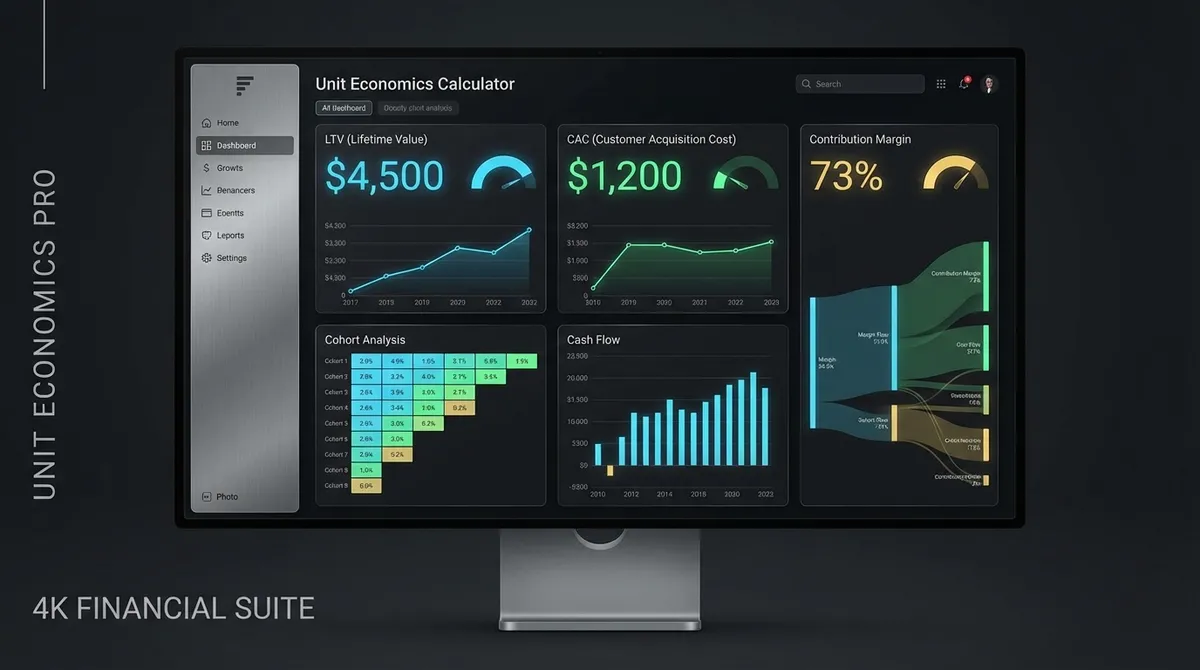
What Are Unit Economics and Why They're Critical for Business Success in 2025
Unit economics is the fundamental analysis of your business model's profitability on a per-unit basis. In the world of SaaS, subscription businesses, and recurring revenue models, understanding unit economics isn't just financial literacy—it's the difference between building a sustainable empire and running a business that bleeds cash with every new customer acquired.
At its core, unit economics answers the most critical question in business: Does each customer you acquire generate more value than they cost to acquire? This simple yet powerful question determines whether your business model is fundamentally sound or fundamentally flawed. Yet surprisingly, 70% of startups fail because they never achieve positive unit economics before running out of capital.
The unit economics framework revolves around three essential metrics: Customer Lifetime Value (LTV), Customer Acquisition Cost (CAC), and Contribution Margin. When these metrics work together harmoniously, you create a growth engine where each new customer generates profit that funds the acquisition of even more customers. When they're out of balance, you create a death spiral where growth actually accelerates your path to bankruptcy.
Key Statistic: SaaS companies with an LTV:CAC ratio above 3.0x grow 2.4x faster than those below 1.5x, while requiring 40% less capital. A healthy LTV:CAC ratio of 3:1 means for every dollar spent acquiring customers, you generate three dollars in lifetime value—a sustainable foundation for scaling your business to millions in revenue.
Understanding Unit Economics Fundamentals: The Building Blocks of Sustainable Growth
Unit economics isn't a single metric—it's a comprehensive framework that reveals the financial health of your customer relationships. To master unit economics, you must understand five interconnected components that determine whether your business model creates or destroys value with each transaction.
1. Average Revenue Per Account (ARPA)
ARPA represents the average monthly or annual revenue generated per customer. This metric forms the foundation of your unit economics analysis because it determines the revenue ceiling for each customer relationship. Increasing ARPA through upselling, cross-selling, or pricing optimization has a multiplier effect on your entire unit economics equation.
For SaaS businesses, ARPA typically ranges from $50 for self-serve products to $5,000+ for enterprise solutions. The key is understanding that small improvements in ARPA compound dramatically: a 20% increase in ARPA combined with a 10% reduction in churn can double your LTV overnight.
2. Gross Margin: The Profit Engine
Gross margin represents the percentage of revenue remaining after subtracting the direct costs of delivering your product (COGS). For SaaS companies, this typically includes hosting costs, customer support, payment processing, and third-party software licenses. Healthy SaaS businesses maintain gross margins of 75-85%, creating substantial profit per dollar of revenue.
Your gross margin directly impacts your contribution margin—the actual profit per customer available to cover fixed costs and generate profit. A SaaS company with 80% gross margin has four times more profit per customer than one with 20% gross margin, even at the same ARPA.
3. Contribution Margin: Profit Per Customer
Contribution margin is calculated as ARPA × Gross Margin, revealing the actual monthly profit generated per customer before fixed costs. This is the engine that powers your growth: every dollar of contribution margin funds customer acquisition, product development, and company operations.
For example, if your ARPA is $200 and your gross margin is 80%, your contribution margin is $160 per customer per month. This $160 must cover your CAC, fixed costs, and ultimately generate profit for the business.
4. Customer Lifetime Value (LTV)
LTV represents the total profit generated by an average customer throughout their entire relationship with your company. The standard formula is: LTV = (ARPA × Gross Margin) ÷ Churn Rate. This metric answers the critical question: "How much is each customer worth to our business?"
A $200 ARPA with 80% gross margin and 5% monthly churn generates $3,200 in LTV. This means each customer you acquire should generate $3,200 in lifetime profit—if you can acquire them for less than that amount, you've created a profitable growth engine.
5. Customer Acquisition Cost (CAC)
CAC represents the total cost to acquire a new customer, including all sales and marketing expenses divided by the number of new customers acquired. This includes digital advertising, sales team salaries, marketing campaigns, content creation, and any other costs directly associated with customer acquisition.
The relationship between LTV and CAC determines your business viability. The golden rule: LTV should be at least 3x CAC for a sustainable business model. Spend $600 to acquire a customer worth $3,200, and you've created $2,600 in value per customer.
Real-World Example: How SaaSStart Scaled to $10M ARR with Perfect Unit Economics
Meet SaaSStart, a project management software company that mastered unit economics from day one. By analyzing their metrics obsessively and making data-driven decisions, they scaled from $0 to $10M ARR in four years while maintaining a healthy LTV:CAC ratio above 3.5x.
When SaaSStart launched, their initial unit economics looked concerning: $100 ARPA, 70% gross margin, 8% monthly churn, and $400 CAC. This generated only $875 LTV with a 2.2x LTV:CAC ratio—below the 3.0x benchmark for sustainable growth. Rather than continuing to spend on acquisition, they focused on improving unit economics first.
Year 1: The Foundation
• ARPA: $100/month
• Gross Margin: 70%
• Churn Rate: 8% monthly
• CAC: $400
• LTV:CAC Ratio: 2.2x
• Payback Period: 14 months
• Churn too high (8% vs. target 5%)
• ARPA too low for sustainable growth
• CAC reasonable but could improve
• Focus: Reduce churn, increase ARPA
Year 2: Optimization Phase
SaaSStart implemented three strategic changes: First, they added a premium tier at $300/month, which 15% of customers upgraded to, increasing overall ARPA to $130. Second, they invested in customer success, reducing churn from 8% to 5% monthly. Third, they optimized their marketing funnel, improving CAC from $400 to $350.
Year 2 Results: With $130 ARPA, 75% gross margin, 5% churn, and $350 CAC, their LTV jumped to $1,950 with a 5.6x LTV:CAC ratio—excellent unit economics that provided a solid foundation for scaling.
Years 3-4: Scaling Phase
With proven unit economics, SaaSStart accelerated customer acquisition. They increased marketing spend by 300%, rapidly growing their customer base while maintaining their improved metrics. The strong LTV:CAC ratio meant each dollar invested in acquisition generated $5.60 in lifetime value, creating a self-funding growth engine.
By Year 4, they hit $10M ARR with 6,400 customers, $130 ARPA, 78% gross margin, 4.5% churn, and $380 CAC—their LTV:CAC ratio remained healthy at 5.4x. The key lesson: master unit economics before scaling acquisition, and growth becomes sustainable and profitable.
5.6x
Final LTV:CAC Ratio
$10M
ARR in Year 4
6,400
Happy Customers
Common Unit Economics Mistakes That Kill SaaS Businesses
Mistake #1: Ignoring Churn Until It's Too Late
Many founders focus obsessively on acquisition while neglecting retention. A 5% monthly churn seems manageable—until you realize it means losing 46% of your customers annually. High churn destroys LTV and makes scaling impossible. The fix: implement customer success programs, product stickiness features, and regular engagement touchpoints from day one.
Mistake #2: Underestimating True CAC
Most companies calculate CAC using only direct marketing spend, ignoring sales team salaries, tools, content creation, and overhead. This underestimates true CAC by 40-60%. The fix: include all sales and marketing expenses—salaries, benefits, software, agency fees, and overhead allocation—in your CAC calculation.
Mistake #3: Scaling Before Achieving Product-Market Fit
Spending heavily on acquisition before achieving strong unit economics is like pouring water into a leaky bucket. If your LTV:CAC ratio is below 3.0x, scaling marketing spend will accelerate cash burn. The fix: focus on improving unit economics first—reduce churn, increase ARPA through value-based pricing, improve gross margins—then scale acquisition.
Mistake #4: One-Size-Fits-All Analysis
Treating all customers the same masks critical insights. Your enterprise customers likely have 10x higher LTV and 5x lower churn than self-serve customers. The fix: perform cohort analysis and segment your unit economics by customer type, acquisition channel, and geography to identify your most profitable segments.
Mistake #5: Optimizing for Vanity Metrics
Focusing on Monthly Recurring Revenue (MRR) growth while ignoring unit economics leads to disaster. You can grow MRR 200% year-over-year while destroying value if your LTV:CAC ratio is below 1.0x. The fix: make LTV:CAC ratio and payback period your primary metrics, with MRR growth as a secondary indicator.
How to Improve Your Unit Economics: Actionable Strategies for Sustainable Growth
Improving unit economics requires systematic optimization across three dimensions: increasing customer value, reducing acquisition costs, and extending customer lifetime. Here are proven strategies for each area.
Increasing Customer Value (LTV)
🎯 Implement Value-Based Pricing
Charge based on the value you deliver, not your costs. If you save customers $1,000/month, charging $200/month (20% of value) is reasonable. This can increase ARPA by 50-200% while maintaining strong retention.
📈 Create Tiered Pricing
Offer basic, professional, and enterprise tiers. This captures more value from larger customers while providing an upgrade path for growing customers. Companies see 30-40% of revenue from upsells using this approach.
🤝 Focus on Customer Success
Proactive customer success can reduce churn by 30-50%. Implement onboarding programs, regular check-ins, and usage monitoring to identify at-risk customers before they churn.
🔄 Annual Billing with Discounts
Offer 10-20% discounts for annual prepayment. This improves cash flow, reduces churn (annual customers churn less), and increases LTV by 15-25% through prepayment acceleration.
Reducing Customer Acquisition Cost (CAC)
🎯 Focus on High-Intent Channels
Shift budget from broad awareness campaigns to high-intent channels like search advertising, review sites, and intent-based content marketing. This can reduce CAC by 40-60% while improving lead quality.
📧 Build Organic Growth Engine
Invest in SEO, content marketing, and product-led growth. Organic channels typically have 50-70% lower CAC than paid channels and compound over time, creating sustainable acquisition advantages.
📊 Implement Lead Scoring
Focus sales efforts on high-probability prospects. Lead scoring based on firmographics, behavior, and engagement can increase conversion rates by 30-50%, dramatically reducing CAC.
💬 Leverage Customer Referrals
Implement a referral program offering incentives for customer recommendations. Referred customers have 25-40% lower CAC and 2x higher LTV than other acquisition channels.
Extending Customer Lifetime
🎮 Increase Product Stickiness
Build features that create switching costs—integrations, data storage, team collaboration, and workflow automation. Each additional integration can reduce churn by 5-10%.
📊 Provide Usage Analytics
Show customers their ROI and usage metrics. When customers see tangible value, they're 3x more likely to renew. Monthly value reports can reduce churn by 20-30%.
🔄 Implement Expansion Revenue
Design your product to grow with customers—usage-based pricing, seat-based pricing, or feature unlocks. Companies with 20%+ expansion revenue see 50% lower net churn.
🚨 Proactive Churn Prevention
Monitor usage patterns and intervene when engagement drops. Early intervention can recover 40-60% of at-risk customers before they churn.
When to Scale: The Unit Economics Decision Framework
Scaling your business before achieving healthy unit economics is the fastest path to failure. Use this decision framework to determine when you're ready to accelerate growth.
Scale Ready Checklist
LTV:CAC Ratio ≥ 3.0x
Your lifetime value should be at least 3x your customer acquisition cost. This provides cushion for overhead, product development, and profitability.
Payback Period ≤ 12 months
Your CAC should be recovered within 12 months. Longer payback periods strain cash flow and increase capital requirements.
Gross Margin ≥ 75%
High gross margins provide the profit per customer necessary to fund acquisition and operations while scaling efficiently.
Churn Rate ≤ 5% monthly
Low churn indicates strong product-market fit and customer satisfaction, essential for predictable growth and high LTV.
Proven Acquisition Channels
You should have at least 2-3 acquisition channels with predictable CAC and conversion rates before scaling spend significantly.
Rule of Thumb: If your LTV:CAC ratio is 4.0x+, payback period is under 6 months, and churn is below 3% monthly, you're in an excellent position to scale aggressively. These metrics indicate a highly efficient business model where growth accelerates value creation.
Industry Benchmarks: How Your Unit Economics Compare
Understanding how your unit economics compare to industry benchmarks helps identify improvement opportunities and validates your business model. Here are the key metrics by business type and stage.
| Business Type | ARPA | Gross Margin | Churn Rate | LTV:CAC | Payback |
|---|---|---|---|---|---|
| SMB SaaS | $50-150 | 70-80% | 5-8% | 2.5-3.5x | 8-18 months |
| Mid-Market SaaS | $150-500 | 75-85% | 3-6% | 3.0-4.5x | 6-15 months |
| Enterprise SaaS | $500-2,000+ | 80-90% | 1-3% | 4.0-6.0x | 4-12 months |
| E-commerce | $75-200 | 30-50% | 10-25% | 1.5-2.5x | 3-8 months |
| Marketplace | $30-100 | 20-30% | 15-30% | 2.0-3.0x | 2-6 months |
2025 Trends Impacting Unit Economics
Several trends are reshaping unit economics in 2025. AI-powered tools are reducing support costs and improving gross margins by 5-10 percentage points. Product-led growth (PLG) motions are lowering CAC by 40-60% compared to traditional sales models. However, rising digital advertising costs have increased CAC by 15-25% across most channels, making organic growth and retention more critical than ever.
Additionally, privacy changes and cookie deprecation are forcing companies to rebuild their attribution models, often revealing that true CAC is 20-30% higher than previously measured. Companies that adapt quickly to these changes maintain their competitive advantage in unit economics.
Conclusion: Building a Sustainable Growth Engine
Unit economics isn't just a set of metrics—it's the foundation of sustainable business growth. By understanding and optimizing your LTV:CAC ratio, contribution margin, churn rate, and payback period, you transform your business from a cash-burning machine into a profit-generating engine.
The most successful companies in 2025 treat unit economics as their primary business health indicator, reviewing these metrics weekly and making strategic decisions based on improving them. They understand that a business with excellent unit economics can survive nearly any market condition, while a business with poor unit economics will fail even in the best markets.
Whether you're a startup founder, growth marketer, or finance professional, mastering unit economics gives you the clarity to make data-driven decisions that create lasting value. Use our calculator regularly to track your progress, identify improvement opportunities, and validate your growth strategies before making major investments in customer acquisition.
Remember: the goal isn't just to grow—it's to grow profitably. Unit economics is your compass for navigating that journey.