Complete Guide to USDA Home Loans (2025)
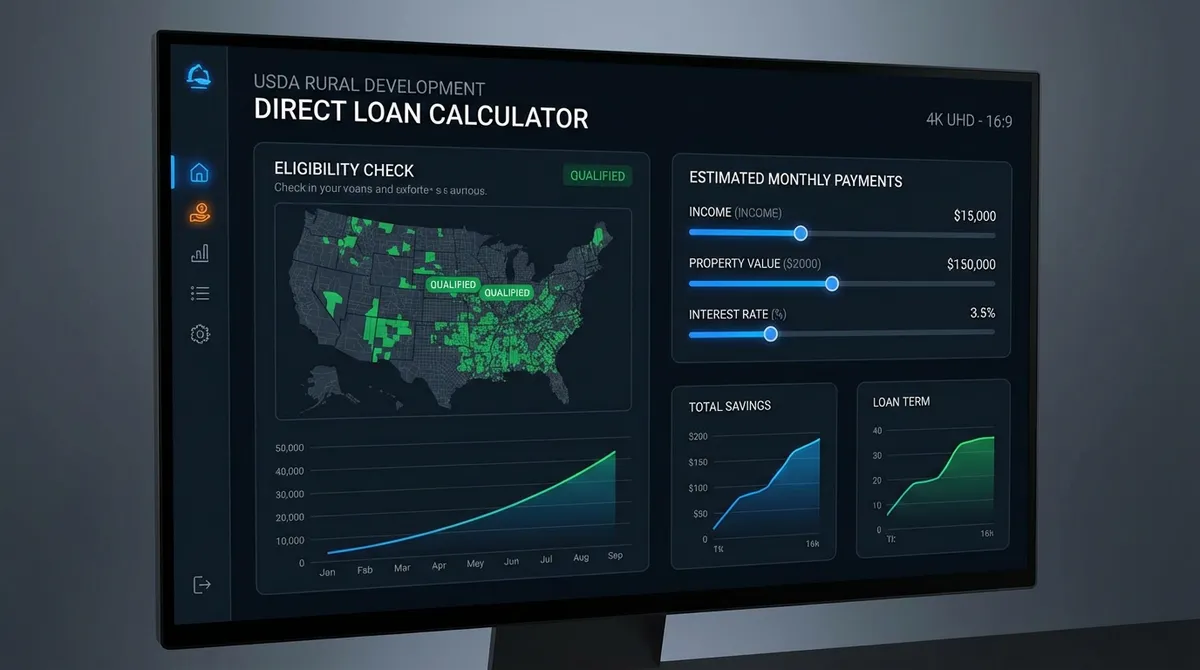
Finding a home with zero down payment might sound like a dream, but for many buyers in 2025, **USDA loans** make it a reality. Backed by the U.S. Department of Agriculture, these loans are designed to boost homeownership in rural and suburban communities. If you're willing to live just outside a major city, you could qualify for one of the most affordable mortgage programs available today.
What Exactly is a USDA Loan?
A USDA loan (officially the **Section 502 Guaranteed Rural Housing Loan**) is a mortgage program that offers **100% financing**. This means you can buy a home without saving for a traditional down payment. It is one of the last remaining 0% down programs available to non-military borrowers (unlike VA loans, which are restricted to veterans).
The program was created in 1991 to promote development in rural areas. Contrary to popular belief, you don't need to buy a farm or live in the middle of nowhere. Many eligible "rural" areas are actually thriving suburban towns on the outskirts of metropolitan areas. The USDA defines "rural" as areas with a population under 35,000, which covers about **97% of the United States land mass**.
Key Benefits at a Glance
- Zero Down Payment: The biggest hurdle to homeownership—saving for a 20% down payment—is removed. You can finance 100% of the home's purchase price.
- Low Mortgage Insurance: USDA loans have both an upfront fee and an annual fee, but they are significantly cheaper than FHA mortgage insurance premiums.
- Flexible Credit Guidelines: While a 640 credit score is the standard for streamlined processing, there are options for those with lower scores through manual underwriting.
- Seller Concessions: Sellers can contribute up to 6% of the sale price toward your closing costs, potentially allowing you to buy a home with almost no money out of pocket.
- Competitive Interest Rates: Because the government guarantees the loan, lenders can offer interest rates that are often lower than conventional loan rates.
Understanding the Fees: Upfront vs. Annual
USDA loans are affordable, but they aren't free. There are two specific fees you need to budget for, which our calculator includes automatically in your monthly payment estimate:
1. Upfront Guarantee Fee (1.00%)
This is a one-time fee of **1% of the loan amount**. Most borrowers choose to roll this fee into their loan balance rather than paying it in cash at closing.
Example: If you buy a $300,000 home, the fee is $3,000. Your total loan amount becomes $303,000.
2. Annual Fee (0.35%)
This works like monthly mortgage insurance (PMI). It is calculated as **0.35% of your remaining loan balance** each year, divided by 12 months.
Example: On a $300,000 loan balance, this adds roughly $87.50 to your monthly payment ($300,000 * 0.0035 / 12).
Comparison: FHA loans charge 0.55% annually. On a $300k loan, the FHA insurance would cost ~$137/month. USDA saves you ~$50/month purely on insurance costs.
Do You Qualify? 2025 Income Limits
USDA loans are strictly for low-to-moderate-income households. You cannot earn *too much* money. The limit is generally set at **115% of the Area Median Income (AMI)**. This ensures the program helps those who need it most.
For most of the country in 2025, estimates suggest:
- 1-4 Person Households: Income limit approx. $110,650 (varies by county).
- 5-8 Person Households: Income limit approx. $146,050 (varies by county).
Pro Tip: USDA looks at "stable" income. You can deduct child care expenses ($480 per child under 18), disability expenses, and medical expenses for elderly family members from your gross income to help you qualify under the limit. Always check the official USDA Eligibility Site for your specific address.
Physical Property Requirements
It is not just the borrower who needs to qualify—the house does too. Since the USDA guarantees the loan, they want to ensure the property is a safe investment. The home must be "modest, safe, sanitary, and sound."
- Square Footage: Generally, the home should not exceed 2,000 square feet, though this is a flexible guideline, not a hard rule.
- No Income-Producing Land: You cannot use a USDA loan to buy a working farm or a property with income-generating structures (like large barns rented out). It must be primarily residential.
- Condition: The appraisal is strict. No peeling paint (lead risk), no broken windows, the roof must have at least 2 years of life left, and all systems (HVAC, plumbing) must work. If the home has a well/septic system, it must pass inspection.
- Pools: In-ground pools are effectively "prohibited" in the value calculation. The appraiser cannot give value to the pool, and often, repairs to the pool cannot be financed.
The 4-Step Application Timeline
The USDA process has one extra step compared to a normal bank loan.
- Pre-Qualification: You talk to a USDA-approved private lender (not the government directly). They pull your credit and check your income against the limits.
- Underwriting: The lender's underwriter approves your file. At this point, you are "conditionally approved."
- USDA Commitment: This is the unique step. The lender sends your package to the USDA state office. USDA agents review the file to ensure no fraud and correct income calculations. This can take 2 days to 2 weeks depending on their backlog.
- Closing: Once USDA signs off (issues the "Commitment"), you can sign the final papers and get your keys.
Detailed Qualification Checklist
- Location: Property must be in an eligible rural/suburban area. You cannot use this loan to buy a condo in downtown Manhattan or Los Angeles.
- Usage: Must be your primary residence (no rentals/vacation homes).
- Credit: A score of 640+ gets you through the GUS (Guaranteed Underwriting System) automated approval. Lower scores (down to ~600) may qualify via manual underwriting but require stricter debt ratios.
- DTI Ratio: Your housing payment (PITI) shouldn't exceed 29% of your gross income, and total debt (including car loans, student loans, credit cards) shouldn't exceed 41%. These are stricter than FHA ratios (which can go up to 50%+). Check your debt ratios.
- Employment: You generally need 2 years of steady employment history, though gaps can be explained (e.g., for school).
USDA vs. FHA: Which Wins?
| Feature | USDA Loan | FHA Loan |
|---|---|---|
| Down Payment | 0% | 3.5% |
| Upfront Fee | 1.0% | 1.75% |
| Monthly Insurance | 0.35% | 0.55% |
| Income Limit | Yes (Strict) | No Limit |
| Location Limit | Yes (Rural Only) | Anywhere |
Strategic Tips for Borrowers
1. **Check the Map First:** Don't waste time looking at homes before you verify elgibility. Start with the USDA eligibility map to define your search area.
2. **Mind the "Income Cliff":** Since income limits are strict, a small raise or bonus could disqualify you. If you are borderline, talk to a loan officer early to calculate your "household" income correctly.
3. **Watch the DTI:** USDA is stricter on debt ratios than FHA. Pay down small credit card balances before applying to boost your approval odds.
4. **Ask for Concessions:** Since you are doing 0% down, you will still have closing costs (~3-5% of loan). Ask the seller to pay these concessions. In a buyer's market, this is very common for USDA deals.
Frequently Asked Questions
Can I refinance a USDA loan?
Yes! USDA offers a "Streamline Refinance" program that allows you to lower your interest rate with very little paperwork and no new appraisal, provided you are current on your payments.
Can I use USDA for a fixer-upper?
Generally, no. The standard USDA Guaranteed loan requires the home to be "safe, sound, and sanitary" upon move-in. It cannot have major structural issues (like a bad roof or foundation). However, there is a specialized "USDA Rehabilitation & Repair" loan, though fewer lenders offer it.
Is there a maximum loan amount?
Technically, no. Unlike FHA or Conventional loans which have strict dollar caps (e.g., $766,550), USDA loans are limited only by your ability to repay. If your income supports a $500,000 mortgage payments within the 29% housing ratio, you can borrow that amount.
How long does the USDA process take?
It can take a bit longer than conventional loans. After your lender approves the file, they must send it to the USDA state office for a final "sign-off." This can add 2-7 days to the closing timeline, so plan for a 35-45 day closing period.