Complete 2025 Guide: Mastering the VA Home Loan
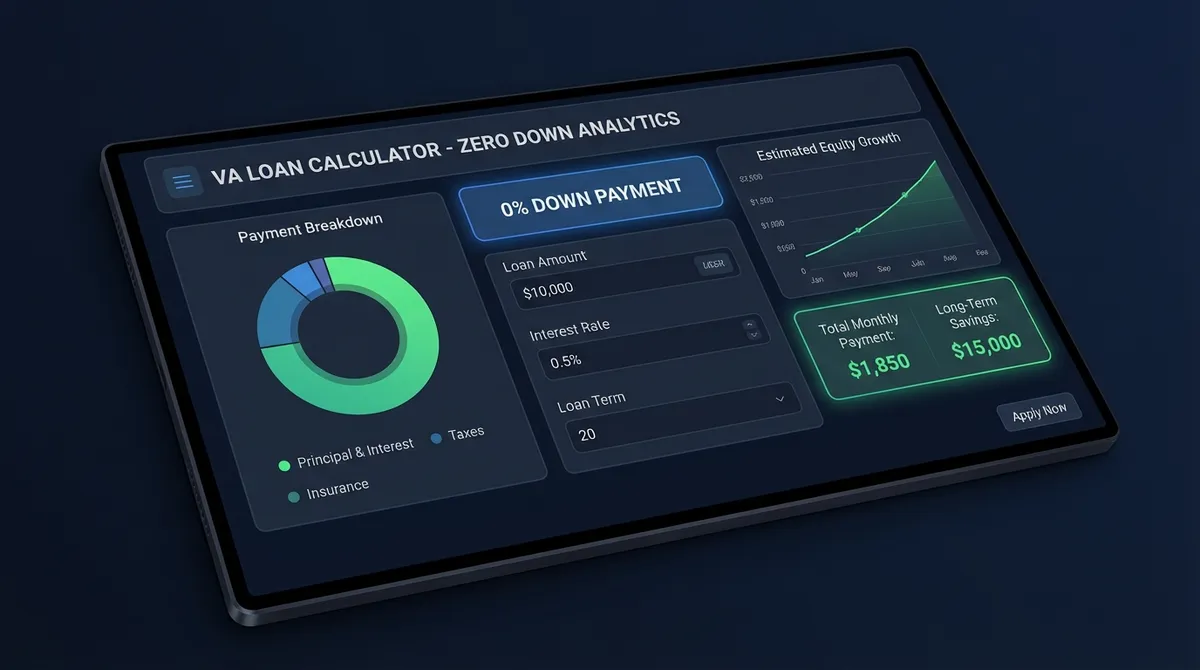
The VA loan is widely considered the most powerful mortgage product on the market—if you know how to use it. Designed exclusively for veterans, active-duty service members, and eligible surviving spouses, it offers a path to homeownership with $0 down payment and no private mortgage insurance (PMI).
But "zero down" doesn't mean "zero cost." Understanding the nuances of the VA Funding Fee, residual income requirements, and debt-to-income limits is crucial to avoiding surprises at the closing table. This guide breaks down exactly how the numbers work in 2025.
How the VA Loan Actually Works
Contrary to popular belief, the Department of Veterans Affairs does not issue loans. Instead, it guarantees a portion of the loan (typically 25%) provided by private lenders like banks and mortgage companies. This guarantee protects the lender against loss if you default, which encourages them to offer you incredibly favorable terms:
- No Down Payment Required: You can finance 100% of the home's purchase price. Conventional loans typically require 3-20%.
- No Private Mortgage Insurance (PMI): Even with 0% down, you never pay monthly mortgage insurance. On a conventional loan, this saves you $100-$300/month.
- Lower Interest Rates: Because of the government backing, VA rates are consistently 0.25% to 0.50% lower than conventional rates.
While VA loans are excellent, it's wise to compare them with FHA loans and USDA loans. Be sure to budget for closing costs.
2025 Update: Loan Limits
For veterans with their full entitlement available, there are no loan limits in 2025. You can borrow as much as a lender is willing to approve based on your income and credit, all with zero down payment. Limits only apply if you have an existing VA loan that you aren't paying off.
The Hidden Cost: VA Funding Fee
The VA Funding Fee is a one-time governmental fee applied to every VA purchase or refinance loan. It helps offset the cost of the loan program to taxpayers. The amount you pay depends on two factors: the size of your down payment and whether this is your first time using a VA loan.
| Down Payment | First Use Fee | Subsequent Use Fee |
|---|---|---|
| None (0%) | 2.15% | 3.3% |
| 5% or more | 1.5% | 1.5% |
| 10% or more | 1.25% | 1.25% |
Example: On a $400,000 home with 0% down, a first-time user pays a fee of $8,600. A subsequent user pays $13,200. Most borrowers choose to finance this fee into the loan rather than paying it cash at closing, which increases your monthly payment slightly.
Who is Exempt from the Fee?
You do NOT pay the Funding Fee if you are:
- A veteran receiving VA compensation for a service-connected disability.
- A veteran entitled to receive compensation for a service-connected disability, but receiving retirement pay or active duty pay instead.
- A surviving spouse of a veteran who died in service or from a service-connected disability.
- An active-duty service member who has received the Purple Heart.
Residual Income: The Secret Qualification Metric
While most loans focus heavily on Debt-to-Income (DTI) ratio, VA loans have a unique "safety net" requirement called Residual Income. The VA wants to ensure you have enough cash left over every month after paying your mortgage and major debts to cover living expenses like food, gas, and utilities.
The required amount varies by region and family size. For example, a family of 4 in the Midwest needs about $1,000 in residual income. If your DTI is high (above 41%), having strong residual income (e.g., 20% above the minimum) can often save your loan and get you approved.
Step 1: proving You Are Eligible
Before applying, you need your "Golden Ticket": the Certificate of Eligibility (COE). This document tells lenders you have sufficient service history to qualify.
Who Qualifies?
- • Veterans: Met minimum active-duty service requirements (e.g., 90 days wartime, 181 days peacetime).
- • Active Duty: Currently serving for 90 continuous days.
- • National Guard/Reserves: 6 years of service (or 90 days active duty under Title 10/32).
- • Surviving Spouses: Unremarried spouses of veterans who died in service or from service-connected disabilities.
How to Get Your COE
You can apply online via the VA eBenefits portal, by mail using Form 26-1880, or—easiest of all—ask your lender to pull it for you instantly through the VA's automated system (WebLGY).
The VA Appraisal: It's Not Just a Value Check
A VA appraisal is two things in one: a valuation of the home and a safety inspection. The appraiser ensures the home meets Minimum Property Requirements (MPRs). If a home has these issues, they must be fixed before closing:
- • Peeling paint (lead risk in homes pre-1978)
- • Lack of safe heating source
- • Roof leaks or significant decay
- • Broken windows or electrical hazards
- • Termite or dry rot damage
- • Lack of clean water supply
*Pro Tip: Fixer-uppers can be tough with a standard VA loan. Consider a VA Rehab Loan if you want to buy a property needing major repairs.
2 VA Loan "Superpowers" You Should Know
1. The Assumable Mortgage
In a high-interest rate environment, this is gold. A VA loan is assumable. This means when you sell your home, the buyer (even a non-veteran!) can take over your existing mortgage rate.
2. The IRRRL (Streamline Refinance)
If rates drop, VA borrowers have the easiest refinance path in the industry: the Interest Rate Reduction Refinance Loan (IRRRL).
- No appraisal required.
- No income verification required.
- Minimal closing costs (and reduced Funding Fee of 0.5%).
Real-Life Scenario: The Math in Action
Let's serve up the numbers for "Staff Sergeant Miller." He wants to buy a home for $350,000.
- Status Active Duty, First-Time Use
- Down Payment $0
- Interest Rate 6.0%
- Property Tax $300/mo
- Home Insurance $100/mo
Monthly Payment Breakdown
- Base Loan Amount$350,000
- Funding Fee (2.15%)+ $7,525
- Total Loan= $357,525
- Principal & Interest$2,143
- Taxes & Insurance+ $400
- Total Payment$2,543
Use the calculator at the top of this page to plug in your own home price and see how your payment changes!
VA Loans: The Good, The Bad, and The Flexible
Pros
- Zero Down Payment: Keep your cash for renovations or investing.
- No PMI: Saves $100-$300/month compared to FHA or Conventional.
- Lower Rates: Government backing lowers risk for lenders.
- Forgiving Credit: Easier to qualify with past credit issues.
XCons
- Funding Fee: Can add 2.15% - 3.3% to your loan balance.
- Strict Appraisals: Homes must be in "move-in ready" condition.
- Primary Residence Only: You cannot use it to buy a pure investment property (unless you live in it).
VA Loan vs. Conventional Loan: The Showdown
Many veterans assume the VA loan is always the best option, but how does it actually stack up against a standard Conventional loan with 20% down? Let's break down the math and the "soft" benefits.
| Feature | VA Loan | Conventional Loan |
|---|---|---|
| Down Payment | 0% | 3% - 20% |
| Mortgage Insurance | None ($0/mo) | PMI required if under 20% down |
| Credit Score | Flexible (often 580+) | Strict (typically 620-740+) |
| Interest Rates | Typically Lower | Market Standard |
| Upfront Fee | Funding Fee (1.25% - 3.3%) | None |
| Debt-to-Income | Flexible (can go >50%) | Strict (max 43-50%) |
The Verdict? If you have less than 20% down, the VA loan is almost mathematically unbeatable due to the lack of PMI and lower interest rate. Even with the Funding Fee, the monthly savings are substantial.
However, if you have 20% down and a 780+ credit score, a Conventional loan might be slightly cheaper overall because you avoid the Funding Fee. But even then, many veterans choose the VA loan to keep their cash liquid for investments or home improvements.
Frequently Asked Questions
Can I use a VA loan for a vacation home?
No. The VA loan is strictly for your primary residence. You must certify that you intend to occupy the property within 60 days of closing. However, you can use it to buy a multi-unit property (up to 4 units) as long as you live in one of the units.
Is there a minimum credit score for VA loans?
Technically, the VA does not set a minimum credit score. However, most private lenders who issue the loans have their own "overlays," typically requiring a score of 580-620. Some lenders specialize in working with lower scores, so it pays to shop around.
Can I have two VA loans at once?
Yes! This is called "bonus entitlement" or "tier 2 entitlement." If you have a VA loan on your current home and get PCS orders to a new duty station, you may be able to buy a second home with a VA loan at the new location without selling the first one, provided you have enough entitlement remaining.