Virginia Income Tax Guide: 2025 Edition
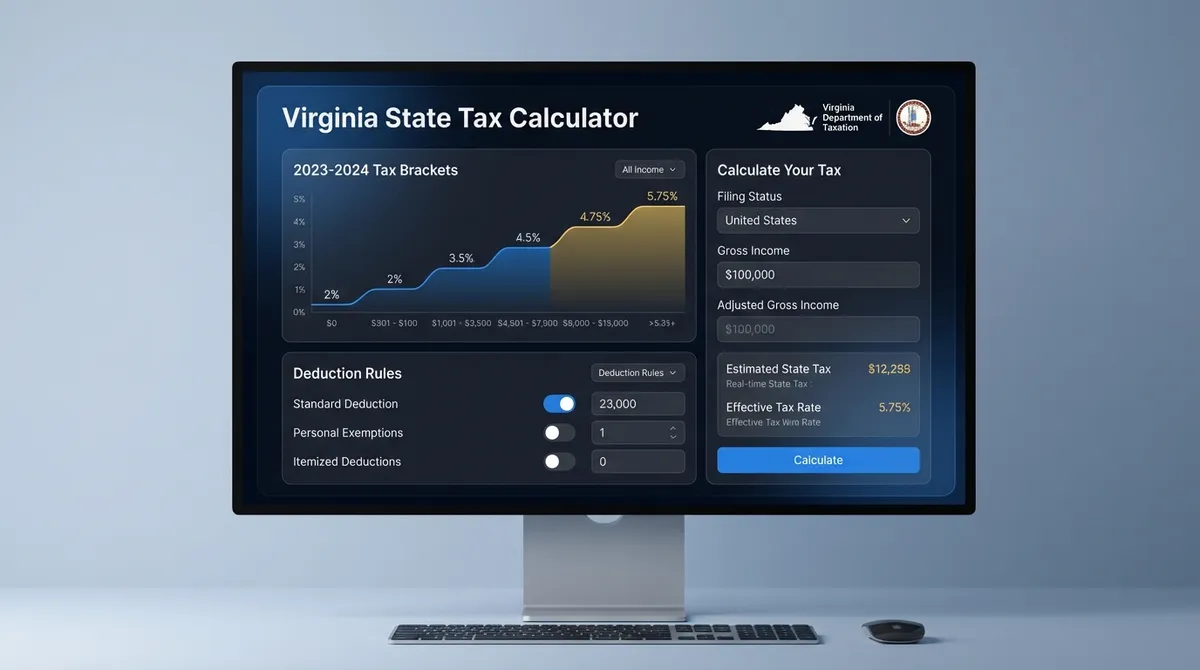
Virginia is unique among states because it doesn't just have one set of rules for everyone—it has a progressive tax system that's been surprisingly stable for decades, yet often misunderstood. If you live in the Commonwealth—whether it's the bustling suburbs of Northern Virginia or the quiet valleys of Roanoke—knowing exactly how much of your paycheck goes to Richmond is essential for your financial health.
The 2025 Virginia income tax landscape remains consistent, with a top rate of **5.75%**. However, recent adjustments to the Standard Deduction (now **$8,000** for singles and **$16,000** for married couples) have significantly lowered the tax burden for many households. This calculator helps you cut through the noise and see your precise liability instantly.
How Virginia Taxes Your Income
Unlike some states with flat taxes (like neighboring North Carolina) or no income tax (like Tennessee), Virginia uses a **progressive bracket system**. This means your first dollar earned is taxed differently than your 50,000th dollar.
| Taxable Income Range | Tax Rate |
|---|---|
| $0 – $3,000 | 2.00% |
| $3,001 – $5,000 | 3.00% |
| $5,001 – $17,000 | 5.00% |
| Over $17,000 | 5.75% |
Key Insight: The top bracket starts very early—at just $17,000 of taxable income. This effectively means most full-time workers in Virginia pay a flat 5.75% on the majority of their income, making the "progressive" nature more about the lower end of the scale.
The Impact of Deductions
Your "Taxable Income" is not your Gross Pay. Before applying those tax rates, Virginia lets you deduct a significant portion of your earnings.
Standard Deduction (2025)
- Single / Married Filing Separately: $8,000
- Married Filing Jointly: $16,000
This is a major jump from previous years (where it was as low as $3,000 for singles not long ago). This change aligns Virginia more closely with federal standards and provides real relief, especially if you are concerned about inflation.
Real-World Calculation Examples
Scenario A: The Recent Graduate
Single filer, earning $50,000 in Richmond.
Tax Breakdown:
- First $3k @ 2%: $60
- Next $2k @ 3%: $60
- Next $12k @ 5%: $600
- Remaining $25k @ 5.75%: $1,437.50
Scenario B: The Power Couple
Married filing jointly, household income $180,000 in Fairfax.
Tax Breakdown:
- First $17k (brackets): $720
- Remaining $147k @ 5.75%: $8,452.50
Strategic Tips for Virginia Taxpayers
- 1Consider the 529 Plan Deduction. Virginia has one of the best 529 benefits in the country. You can deduct up to $4,000 per account, per year, from your Virginia taxable income. For a married couple with two kids and multiple accounts, this can be significant.
- 2Military Benefits are Strong. Up to $10,000 of military basic pay is exempt. Plus, if you are a recipient of the Medal of Honor, your military retirement income is 100% tax-free in Virginia.
- 3Don't Forget the Age Deduction. If you were born on or before Jan 1, 1939, you can claim a huge deduction ($12,000 individual). Even if you are slightly younger (65+), there are income-based subtractions available.
Note on Local Taxes
Unlike Maryland, Virginia cities and counties generally do not levy their own income tax. However, you will pay "Personal Property Tax" on your vehicle (often called the "Car Tax"), which is completely separate from this income tax calculation.
The "Hidden" Virginia Tax: Personal Property
While Virginia doesn't have local income cities, it is infamous for its Personal Property Tax on vehicles. This is an annual tax based on the assessed value of your car, truck, or motorcycle.
Are You a Virginia Resident?
It seems like a simple question, but for tax purposes, it can get complicated. Virginia recognizes two types of residents:
1. Actual Resident
You are physically present in Virginia for more than 183 days (6 months) during the tax year. Even if your "permanent home" is technically in Florida, if you sleep in Virginia for 184 nights, you are a resident for tax purposes.
2. Domiciliary Resident
Virginia is your permanent legal home. Even if you are away for the entire year (e.g., teaching English abroad or on a temporary work assignment), if you intend to return, you remain a Domiciliary Resident and owe Virginia tax on your worldwide income.
Check your credit report often to ensure your address history is accurate using our credit report guide.
Important 2025 Tax Dates
- May 1
Filing Deadline
Your Form 760 is due. Note: This is different from the Federal April 15 deadline!
- Nov 1
Extension Deadline
If you filed an extension, this is the last day to file your return (payment was still due May 1).
- Jan 15
Q4 Estimated Payment
Final estimated tax payment due for the previous tax year.
Common Virginia Forms
The Resident Income Tax Return. Most people file this.
Used if you aren't a resident but earned income in VA.
For adding/subtracting items (like 529 contributions).
Frequently Asked Questions
Does Virginia tax Social Security?
No. Virginia does not tax Social Security benefits. If your SS income is included in your Federal Adjusted Gross Income (AGI), you subtract it entirely on your Virginia return.
What is the "Commuter Tax" Reciprocity?
Virginia has reciprocity with Kentucky, Maryland, Pennsylvania, West Virginia, and Washington D.C. If you live in Virginia but work in D.C., you pay Virginia income tax, not D.C. tax. You should file an exemption form (like Form D-4A for D.C.) with your employer so they withhold VA tax instead of the work state's tax.
Is there a standard deduction for seniors?
Virginia offers an "Age Deduction" rather than just a higher standard deduction. If you were born on or before Jan 1, 1939, you claim $12,000. For those born between 1939 and 1959, the deduction is income-based. This is in addition to the personal exemption, making Virginia reasonably tax-friendly for retirees.
When are Virginia taxes due?
Virginia state tax returns (Form 760) are due May 1st, which is usually two weeks after the potential Federal deadline. However, most people file them together in April to get their refunds sooner.
How do I amend a Virginia tax return?
If you made a mistake on a previously filed return, you must file an amended return using Form 760 (for residents) and fill in the "Amended Return" oval on the form. You generally have 3 years from the original due date to claim a refund.
Strategic Tax Planning for High Earners in VA
Residents of counties like Loudoun, Fairfax, and Arlington often have higher-than-average incomes, pushing them squarely into the 5.75% bracket. Here are advanced strategies to mitigate that liability:
Maximize HSA Contributions
Health Savings Accounts (HSAs) are triple-tax-advantaged. Contributions reduce your Federal AGI, which flows through to your Virginia return, effectively shielding that money from the 5.75% state tax as well. Learn more with our HSA calculator.
Municipal Bonds
Interest income from Virginia municipal bonds is typically exempt from both federal and state income taxes. However, bonds from other states are taxable in Virginia, so choose your portfolio carefully using an investment calculator.
Land Preservation Tax Credit
Virginia offers a unique credit for landowners who donate land or easements for conservation. This is one of the most generous credits available, offering 40% of the fair market value as a tax credit.
ABLE Accounts
For families with disabled individuals, Virginia ABLEnow accounts allow you to save for disability-related expenses. Contributions are deductible up to $2,000 per contributor per year.
Summary
Virginia's tax system is stable and predictable. With a top rate of 5.75% that kicks in early, most working professionals should budget for that rate. However, generous deductions for 529 plans, military pay, and standard deductions help lower the effective burden. For more federal tax info, verify with IRS.gov.
Use the calculator above to plan your withholdings. If you end up owing money at the end of the year, adjust your W-4 or VA-4 immediately to avoid penalties next year.