Mastering Your W-4 in 2025: Keep More of Your Money
The W-4 form is one of the most important—and misunderstood—financial documents you'll ever sign. It acts as a set of instructions for your employer, telling them exactly how much federal income tax to withhold from every paycheck.
Get it wrong, and you essentially give the IRS an interest-free loan for a year (a huge refund) or, worse, end up with a surprise tax bill and penalties in April. Our 2025 W-4 Withholding Calculator helps you find the "Goldilocks" zone: withholding just enough to cover your liability without shrinking your monthly cash flow.
Why This Matters for 2025
The standard deduction has increased to $15,000 for singles and $30,000 for married couples in 2025. If you haven't updated your W-4 recently, outdated settings could mean your withholding is no longer accurate—check your tax bracket.
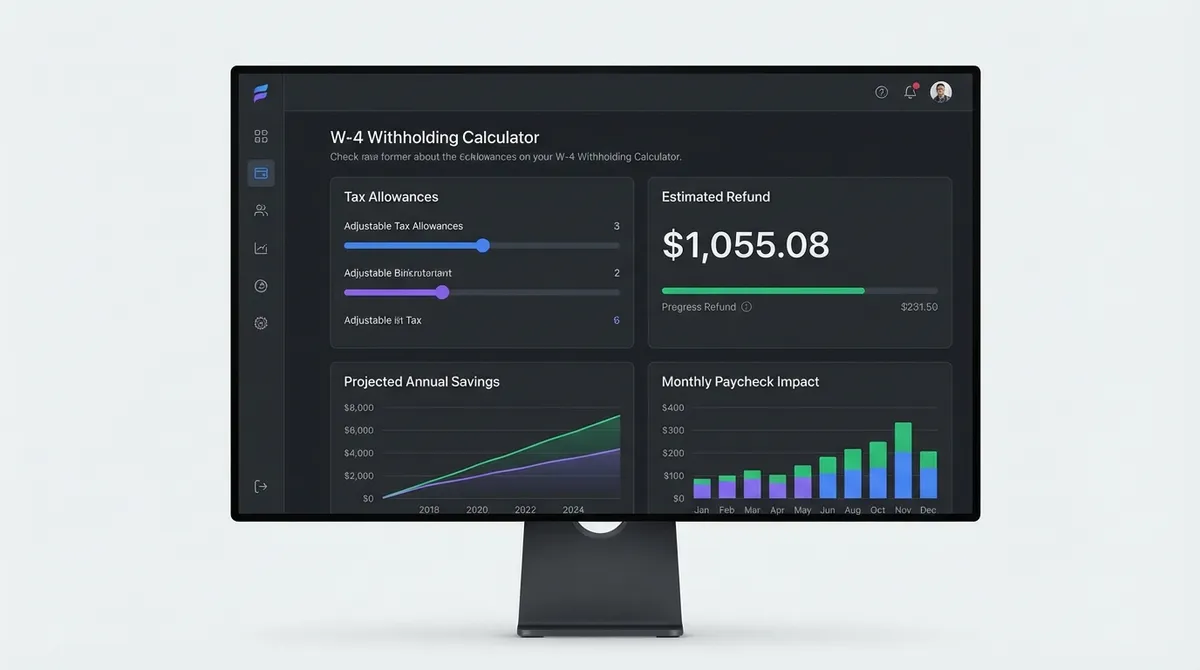
The 5 Steps of the W-4 Form: A Detailed Walkthrough
The form was redesigned in 2020 to be more accurate but slightly more complex. Here is exactly what to do in each section:
Step 1: Personal Information
Enter your name, address, and Social Security number. Crucially, you must select your filing status (Single, Married Filing Jointly, or Head of Household). This selection determines the standard tax rates applied to your paycheck—use a paycheck calculator to test scenarios.
Step 2: Multiple Jobs or Spouse Works
Do not skip this if it applies to you. If you hold two jobs or your spouse also works, you must account for that extra income.
- Option A (Most Accurate): Use the IRS Tax Withholding Estimator.
- Option B (Easiest): Check the box in Step 2(c) on both jobs' forms. This withholds at a higher single rate for both.
Step 3: Claim Dependents
This is where you lower your taxes. Enter $2,000 for each child under 17 and $500 for other dependents. This directly reduces your withholding, meaning you get more money in your paycheck now rather than waiting for a refund.
Step 4: Other Adjustments (Optional)
4(a) Other Income:
Have interest, dividends, or retirement income from a 401k? Enter the annual amount here to have tax withheld from your paycheck to cover it.
4(b) Deductions:
If you itemize deductions (mortgage interest, charity) instead of taking the standard deduction, use the worksheet and enter the amount here to reduce withholding.
4(c) Extra Withholding:
Want a bigger refund? Enter an extra dollar amount (e.g., $50) to be taken out of every paycheck.
Step 5: Sign Here
The form is invalid without your signature and date.
When Should You Update Your W-4?
We recommend checking your withholding ("Payroll Checkup") every year, but you literally must update it if:
You Get Married or Divorced
Your tax brackets shift dramatically. You might need to re-evaluate your budget.
You Have a Baby
That's a $2,000 Child Tax Credit you can claim immediately.
Your Income Changes
A big raise might push you into a higher bracket, requiring extra withholding.
You Pick Up a Side Hustle
Self-employment income isn't taxed automatically. Adjust your W-4 to cover it or check our 1099 tax calculator.
The "Tax Trap": Underpayment Penalties
If you withhold too little, you don't just owe a big bill in April—you might owe the IRS interest and penalties.
The Safe Harbor Rule
You can avoid penalties if you pay at least:
- 90% of the tax you owe for the current year, OR
- 100% of the tax you owed last year (110% if you are a high earner).
Exempt Status: Are You Eligible?
You might see a box that says "Exempt" on the W-4. This means zero federal income tax is withheld. You can only claim this if:
- You had no federal tax liability last year (you got all your withheld money back).
- You expect to have no federal tax liability this year.
Warning: Claiming exempt when you are not eligible is perjury and results in a massive tax bill.
Strategy: Married Filing Jointly vs. Separately
Step 1 asking for your filing status is the most critical decision on the form. 95% of married couples save money by filing jointly, but there are exceptions.
Why File Jointly?
- Unlocks Credits: Earned Income Tax Credit (EITC), Child and Dependent Care Credit, and education credits are often disallowed for separate filers.
- Higher Standard Deduction: You get a combined deduction of $30,000 (2025), which simplifies filing.
- Lower Tax Rates: Income brackets are wider, keeping you in lower tax tiers for longer.
Why File Separately?
- Student Loans: If you are on an Income-Driven Repayment (IDR) plan like SAVE, filing separately can exclude your spouse's income from your payment calculation, potentially saving you hundreds per month.
- Medical Expenses: If one spouse has huge medical bills (>7.5% of AGI), separating income might allow you to deduct them.
- Liability Protection: Keeps you safe from your spouse's tax debts or back taxes.
State W-4s vs. Federal W-4
The federal W-4 only covers federal income tax. Many states (like California, New York, Georgia) have their own withholding forms (e.g., DE-4, IT-2104).
- No Income Tax States: If you live in WA, TX, FL, TN, NH, NV, SD, WY, or AK, you do not need to fill out a state form.
- Generic States: Some states just accept the federal W-4 for state purposes.
A Brief History: Why Do We Have a W-4?
Before 1943, Americans paid their income taxes in one lump sum the following year. This system collapsed during World War II when the government needed immediate cash flow to fund the war effort.
The Current Tax Payment Act of 1943 introduced the concept of "Pay As You Go" withholding. It was sold as a way to make paying taxes "easier" (by spreading it out), but it essentially gave the government a steady stream of revenue from every paycheck in America. The W-4 was created to tell employers how much to take.
Remote Workers & Digital Nomads
If you live in one state but work for a company in another, your W-4 situation gets complicated.
- General Rule: You pay taxes where you physically work (i.e., your home office), not where the company HQ is. You should fill out a state withholding form for your residence state.
- Convenience of the Employer Rule: Five states (NY, CT, DE, NE, PA) are aggressive. If you work remotely for a NY company, NY might demand income tax unless your employer explicitly requires you to be out of state. You might need to file two state returns and claim a credit for double taxation.
3 Common W-4 Mistakes to Avoid
1. The "Set It and Forget It" Error
Most people only fill out a W-4 when they start a job. If you got married, had a kid, or bought a house in the last 5 years and didn't update it, your withholding is wrong.
2. The "Two-Earner" Trap
If you and your spouse both work, and you both select "Married Filing Jointly" without checking the box in Step 2(c), you will massively underpay. The W-4 assumes a single income household by default.
3. Ignoring Gig Work
If you drive for DoorDash on weekends, that income is untaxed. If you don't add extra withholding to your W-2 job (Step 4c) to cover it, you'll get hit with a bill.
Frequently Asked Questions
Should I claim 0 or 1?
This is the old W-4 system (allowances). On the new 2025 W-4, allowances are gone. Now, you use actual dollar amounts (Step 3). Claiming "0" is roughly equivalent to leaving Steps 3 and 4 blank.
Does claiming dependents affect my actual tax liability?
No. The W-4 only changes when you pay your tax (paycheck vs. annual filing). It does not change the total amount of tax you owe for the year.
Is Head of Household better than Single?
Yes, it has lower tax rates and a higher standard deduction. However, you can only claim it if you are unmarried and pay more than half the cost of maintaining a home for a qualifying person.