Wisconsin Paycheck Calculator: 2025 Tax Guide & Analysis
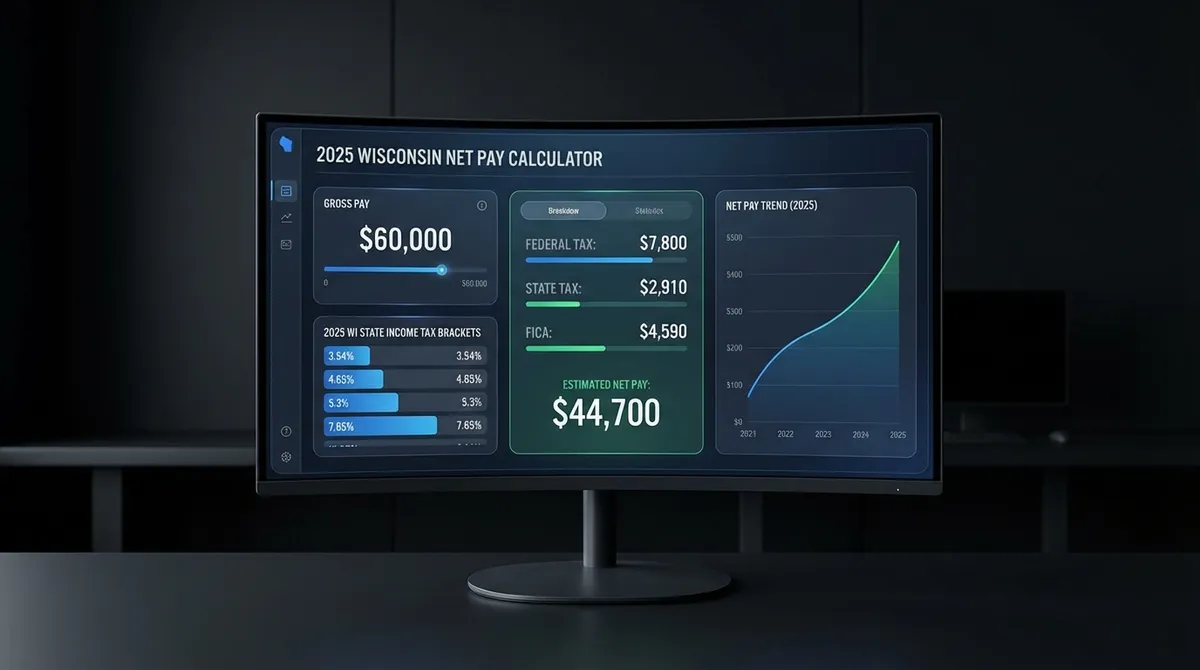
If you live and work in Wisconsin, you've likely noticed your tax situation is a bit more complex than in neighboring states. With a progressive income tax system that includes four distinct brackets and a unique sliding scale standard deduction, manually calculating your take-home pay can be a headache.
For 2025, the landscape has shifted again. Inflation adjustments have raised the income thresholds for tax brackets (meaning you can earn more before hitting higher rates) and increased the standard deduction limits. Our 2025 Wisconsin Paycheck Calculator is engineered to handle these complexities instantly, giving you a precise look at your net pay whether you're in Milwaukee, Madison, Green Bay, or anywhere in the Badger State.
2025 Tax Updates at a Glance
- New Brackets: The 5.30% tax bracket for single filers now starts at $50,480 (up significantly from previous years), offering relief to middle-income earners.
- Sliding Scale Deduction: The standard deduction for single filers is now $18,560 but phases out as income rises above $24,440.
- Federal Changes: Updated IRS brackets and a higher standard deduction ($15,000 for singles) further reduce your taxable income.
How Wisconsin Taxes Your Paycheck
Wisconsin uses a "progressive" tax system. This doesn't mean you pay a higher rate on all your income if you earn more. Instead, your income is sliced into chunks, and each chunk is taxed at a specific rate.
| Tax Rate | Single Filers (Taxable Income) | Married Joint (Taxable Income) |
|---|---|---|
| 3.50% | $0 – $14,680 | $0 – $19,580 |
| 4.40% | $14,681 – $29,370 | $19,581 – $39,150 |
| 5.30% | $29,371 – $323,290 | $39,151 – $431,060 |
| 7.65% | $323,291+ | $431,061+ |
The "Sliding Scale" Standard Deduction
This is where Wisconsin gets unique. Unlike the federal deduction which is a flat amount for everyone, Wisconsin's standard deduction decreases as your income increases.
- Low Earners: Get the maximum deduction ($18,560 for singles in 2025).
- Middle Earners: The deduction shrinks by approximately 12% for every dollar earned above a certain threshold ($24,440 for singles).
- High Earners: Once income exceeds roughly $179,000 (for singles), the standard deduction disappears completely ($0).
Real-World Payroll Examples (2025)
The Madison Grad
Profile: Single, earning $55,000/year.
- Gross Pay:$4,583.33 /mo
- Federal Tax:-$368.00
- FICA (SS + Med):-$350.63
- WI State Tax:-$198.00
- Net Pay:~$3,666 /mo
*Uses partial standard deduction due to income level. For hourly conversions, use our Salary to Hourly Calculator.
The Milwaukee Manager
Profile: Married, earning $120,000/year, 5% to 401(k).
- Gross Pay:$10,000.00 /mo
- 401(k) (Pre-tax):-$500.00
- Federal Tax:-$1,020.00
- FICA:-$765.00
- WI State Tax:-$475.00
- Net Pay:~$7,240 /mo
Advanced: How to Keep More of Your Paycheck
1. Maximize "Pre-Tax" Deductions
The most effective way to lower your Wisconsin tax bill is to lower your taxable income before the state even sees it. Contributions to a 401(k), 403(b), or traditional TSP come out of your gross pay before federal and state taxes are calculated. Curious about your effective rate? Check the Federal Income Tax Calculator.
2. The "Edvest" 529 Advantage
Wisconsin has one of the best state tax benefits for education savings. Contributions to the Edvest 529 Plan are deductible from your Wisconsin taxable income up to roughly $3,800 per beneficiary per year (inflation-adjusted annually).
- Deduct contributions for children, grandchildren, or even yourself.
- Carry forward excess contributions to future tax years.
- Growth is tax-free when used for qualified education expenses.
3. Itemized Credit (Instead of Deductions)
Federal law lets you "itemize deductions." Wisconsin is different; it offers an Itemized Deduction Credit. If your federal itemized deductions (mortgage interest, charity, medical) exceed your Wisconsin standard deduction, you get a 5% credit on the difference. It's complex, but worth calculating if you own a home.
Moving to Wisconsin?
If you are relocating to the Badger State in 2025, here is a quick survival guide for your paycheck:
Part-Year Resident
You will file as a "Part-Year Resident." You only pay WI tax on income earned while living here. Keep your paystubs from your move date distinct!
Reciprocity Check
Coming from IL, IN, KY, or MI? You might not need to pay WI tax at all if you commute. File form W-220 with your new employer immediately.
Wisconsin vs. Neighbors: Paycheck Showdown
How does a Wisconsin paycheck stack up against living in Minnesota, Illinois, or Iowa? It's a common question for those living near the borders.
vs. Illinois
Illinois has a flat tax rate of 4.95%. For low-to-middle earners, Wisconsin's progressive rates (starting at 3.50%) might actually result in higher take-home pay. However, high earners often prefer IL's flat rate over WI's top bracket of 7.65%. Property taxes are generally higher in IL.
vs. Minnesota
Minnesota tax rates are generally higher, starting at 5.35% and climbing to 9.85%. A $60,000 salary usually goes further in Wisconsin due to both lower income taxes and a generally lower cost of living compared to the Twin Cities metro area.
vs. Iowa
Iowa is transitioning to a flat tax system (targeted 3.9% by 2026). Historically high-tax, Iowa is becoming more competitive. Currently, for 2025, Wisconsin often wins for middle-income earners thanks to its generous sliding scale standard deduction.
Bonus & Supplemental Pay in Wisconsin
Did you get a signing bonus or a performance reward? Wisconsin treats this as "supplemental wages." Employers typically have two ways to withhold tax from these checks:
- A
Aggregate Method
Your bonus is added to your regular paycheck, and the tax is calculated as if that total amount is your normal pay period earnings. This often pushes you into a higher tax bracket temporarily, resulting in higher withholding (which you'll get back as a refund if you overpaid).
- B
Percentage Method
Wisconsin allows employers to withhold a flat rate on supplemental pay, similar to the federal flat rate (22%). This is simpler but might not exactly match your annual liability.
Frequently Asked Questions
Is overtime pay taxed differently in Wisconsin?
No. Overtime pay is treated as regular earned income. However, a large overtime check might push that specific pay period into a higher withholding bracket using the aggregate method, making it seem like it's taxed higher at the moment. You'll likely get the difference back when you file your annual return. You can estimate this impact with our Overtime Calculator.
Does Wisconsin tax 401(k) contributions?
Generally, no. Traditional 401(k) contributions are pre-tax for both federal and Wisconsin income tax purposes. This means they are deducted from your gross pay before tax is calculated. However, they are still subject to Social Security and Medicare taxes (FICA Tax Calculator).
What is the "Reciprocity" agreement Wisconsin has?
Wisconsin has tax reciprocity with Illinois, Indiana, Kentucky, and Michigan. If you live in one of these states but work in Wisconsin, you only pay income tax to your home state. For more details, visit the Wisconsin Department of Revenue.
Are there local income taxes in Wisconsin?
Unlike states like Ohio or Pennsylvania, Wisconsin does not have city or county income taxes for individuals. You only deal with Federal and State income taxes, simplifying your payroll calculation.
Why is my standard deduction $0 in the calculator?
This happens for high earners. Wisconsin uses a unique sliding scale where the standard deduction completely phases out once your income exceeds a certain level (approx. $133,000 to $179,000 depending on filing status). If your income is above this cap, you do not receive a standard deduction for state tax purposes, increasing your effective rate.
How does the Homestead Credit work?
This is a tax benefit for renters and homeowners with low to moderate income, designed to lessen the impact of property taxes and rent. It is a "refundable" credit, meaning you can get money back even if you owe no tax. It requires a separate schedule (Schedule H) when you file.
What about HSA contributions?
Health Savings Account (HSA) contributions are typically pre-tax for both federal and Wisconsin purposes, provided they are made through a cafeteria plan at work or deducted on your return. However, always double-check with the latest state statutes as Wisconsin conformity to federal HSA rules has been complex in the past (though generally aligned now for contributions).
How do I adjust my Wisconsin withholding?
You need to file a Form WT-4 (Employee's Wisconsin Withholding Exemption Certificate) with your employer. This is the state equivalent of the federal W-4. If you find you owe money each year, you can reduce your exemptions on this form or ask for an additional dollar amount to be withheld from each paycheck.
Understanding Marginal vs. Effective Tax Rate
Many filers confuse their "tax bracket" with the actual percentage of income they pay. It is important to distinguish between the two:
Marginal Tax Rate
This is the tax rate applied to the very last dollar you earned. For example, if you earn $100,000, your last dollar falls into the 5.30% Wisconsin bracket. This is the rate you would pay on a bonus or raise.
Effective Tax Rate
This is the actual percentage of your total income that went to taxes. Because your first chunks of income were taxed at 3.50% and 4.40%, your effective rate on $100,000 is much lower than 5.30%—typically closer to 4.8%. This is the number that matters for your budget.
Disclaimer: This calculator and guide are for informational purposes only. While we update our data to reflect 2025 tax laws (including Wisconsin's simplified tax brackets and sliding scale deduction), we are not tax professionals. Tax laws vary by individual situation. Please consult a CPA or tax advisor for professional advice.